


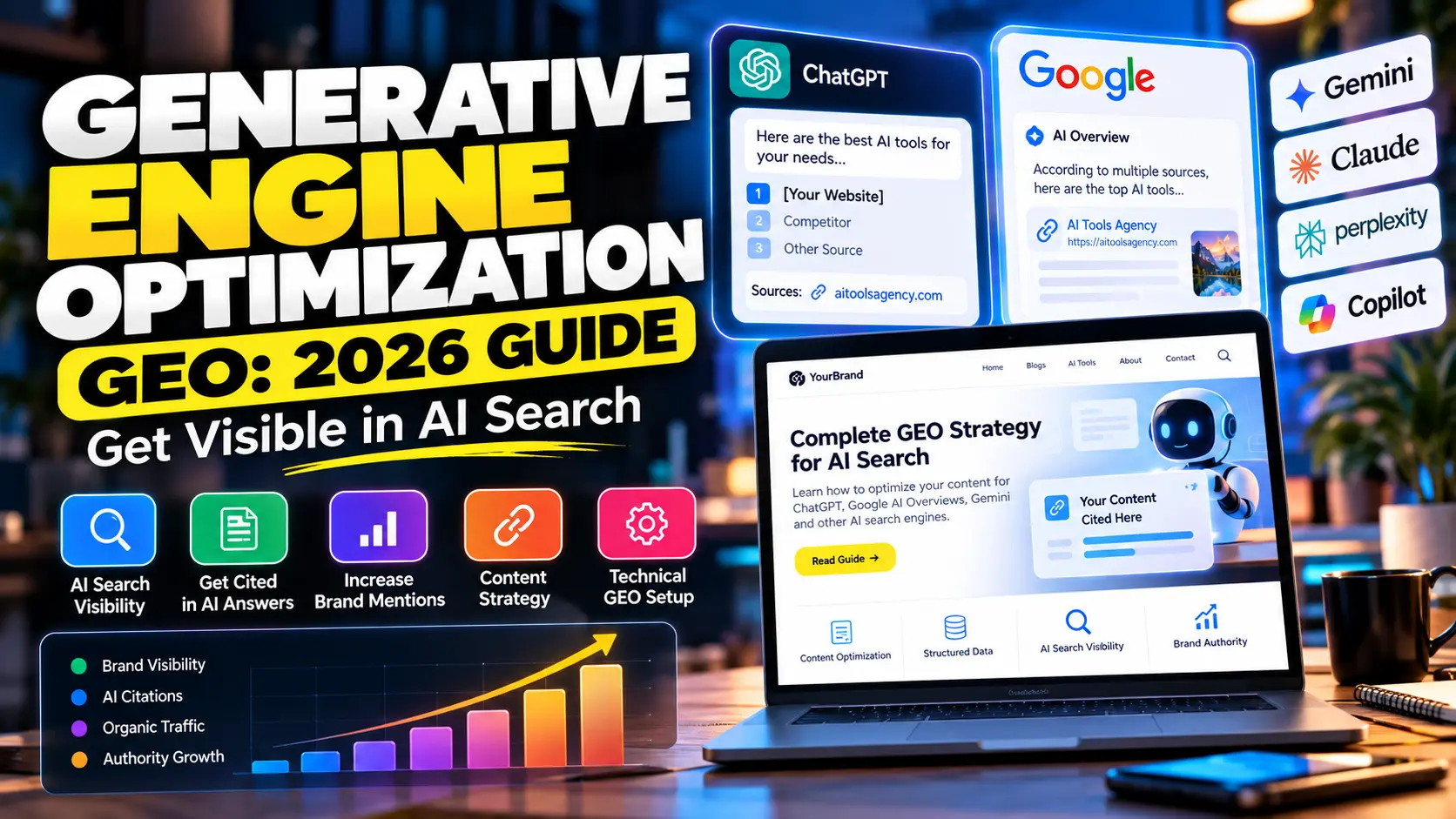
Search is changing.
For years, businesses focused mainly on ranking traditional webpages in Google. They researched keywords, built backlinks, optimized content, and tried to move higher in search results.
However, users are increasingly getting answers directly from AI.
Google now places AI-generated experiences such as AI Overviews and AI Mode inside Search. Meanwhile, tools such as ChatGPT can search the web and cite sources directly inside their responses.
As a result, marketers are paying more attention to Generative Engine Optimization.
Generative Engine Optimization, usually shortened to GEO, is the practice of improving your website and brand so AI-powered search systems can discover, understand, cite, and accurately describe your content.
The topic itself is growing quickly. Ahrefs currently estimates around 7,200 monthly U.S. searches for “generative engine optimization,” representing approximately 84% year-over-year growth.
Therefore, businesses that depend on online discovery should understand GEO alongside traditional SEO.
This guide explains what Generative Engine Optimization means, how it differs from SEO, and how you can improve your chances of appearing in AI-generated answers.
If you are still exploring the broader AI ecosystem, our AI Tools hub covers AI tools, reviews, comparisons, automation, and practical guides.
What Is Generative Engine Optimization?
Generative Engine Optimization is the process of making your website, brand, and information easier for generative AI systems to find, understand, trust, and reference.
Ahrefs describes GEO as the work of increasing brand visibility and accurate representation inside AI-generated answers, including environments such as Google AI Overviews, ChatGPT, and Gemini.
Traditional SEO usually tries to earn a position in a list of search results.
GEO has a slightly different objective.
The goal is to become part of the answer itself.
For example, imagine someone asks an AI assistant:
What are the best AI website builders for small businesses?
A traditional SEO strategy tries to make your article rank highly when someone searches that phrase.
Meanwhile, GEO also tries to make your research, brand, or website useful enough that the AI system cites or mentions it while generating its response.
Therefore, GEO does not replace SEO.
Instead, it extends search optimization into AI-generated discovery.
Why Generative Engine Optimization Matters in 2026
AI-assisted search is no longer a small experiment.
Google reported in June 2026 that AI Overviews had surpassed 2.5 billion monthly active users, while AI Mode had passed one billion monthly users.
In addition, Google says users are asking entirely new types of questions through generative search experiences.
That creates a new discovery channel for publishers, brands, creators, and businesses.
Traditional searches often look like:
best CRM software
An AI-oriented search may be much more detailed:
What is the best CRM for a five-person digital agency that needs WhatsApp integration, automation, and simple reporting?
Those longer questions require systems to understand context rather than match a single keyword.
Consequently, websites need to provide clear and useful information that can support detailed answers.
GEO vs SEO: What Is the Difference?
SEO and GEO overlap heavily.
Both benefit from useful content, technical accessibility, trustworthy information, strong site structure, and authority.
However, their immediate goals can differ.
| Area | Traditional SEO | Generative Engine Optimization |
|---|---|---|
| Main goal | Rank in search results | Appear or get cited in AI answers |
| User experience | Search → click → website | Question → generated answer → possible citation |
| Query style | Often shorter keywords | Often conversational questions |
| Success signals | Rankings, clicks, traffic | AI mentions, citations, referral traffic, brand visibility |
| Content requirement | Relevant and optimized | Relevant, clear, factual, citable and well structured |
| Authority | Backlinks, brand trust, topical relevance | Traditional authority plus consistent trusted mentions |
Ahrefs argues that AI search still builds on many traditional SEO foundations. In other words, strong SEO can also improve the chance that AI systems discover useful pages.
Therefore, you should not abandon SEO to chase GEO.
A stronger strategy combines both.
Does GEO Mean You Need to Rewrite Your Entire Website?
Usually, no.
Google’s own current guidance does not recommend abandoning normal search fundamentals for a completely separate AI-only strategy.
Instead, Google emphasizes useful, original content, clear organization, strong page experience, and high-quality visual content for generative search visibility.
That means a high-quality existing website may already have much of the foundation required for GEO.
However, you may need to improve how clearly your information is presented.
For example, a vague marketing paragraph can be difficult to interpret.
Compare:
We deliver revolutionary next-generation solutions that transform digital experiences.
with:
AI Tools Agency publishes AI tool reviews, comparisons, automation tutorials, and practical guides for businesses and creators.
The second statement is easier for both users and machines to understand.
It clearly explains the entity, topic, and purpose.
1. Answer Questions Clearly
One of the most useful GEO habits is answering questions directly.
Do not force visitors to read 700 words before they understand the answer.
For example, if the heading is:
What Is an AI Website Builder?
Start with a direct definition:
An AI website builder uses artificial intelligence to generate website layouts, content, images, and design elements from user instructions.
Then provide additional explanation.
This structure helps human readers quickly understand the topic.
Moreover, clearly expressed facts are easier for search and AI systems to process.
Your recent AI Website Builder guide follows this type of informational structure.
2. Create Content Around Real Questions
Keyword research remains useful.
However, AI search makes conversational questions increasingly important.
Instead of thinking only about:
AI voice generator
also think about questions such as:
Which AI voice generator is best for YouTube?
Can I commercially use AI-generated voices?
Which AI voice tools support multiple languages?
What is the cheapest AI voice generator?
One detailed article can naturally answer several related questions.
Therefore, you can build broader topical coverage without creating dozens of nearly identical pages.
Our AI Voice Generator comparison is an example of a topic that can answer several related user questions within one page.
3. Use Clear H1, H2, and H3 Structure
Content structure matters for readability.
It also helps systems understand relationships between sections.
A well-organized article may look like:
H1: Generative Engine Optimization
H2: What Is Generative Engine Optimization?
H2: GEO vs SEO
H2: How to Improve AI Visibility
H3: Create Original Research
H3: Add Clear Definitions
H3: Keep Content Updated
Google’s current guidance specifically highlights organizing content clearly for generative search.
Therefore, avoid pages built from one enormous wall of text.
Use descriptive headings that explain exactly what each section covers.
4. Publish Original Information
Generic content is becoming increasingly difficult to differentiate.
If ten websites rewrite exactly the same information, there is little reason for an AI system or user to prefer the eleventh version.
Therefore, add information that comes from your own work.
This could include:
- screenshots from your testing;
- original comparisons;
- measured results;
- personal workflow observations;
- case studies;
- unique tables;
- interviews;
- product tests;
- original images.
Google’s 2026 guidance specifically encourages unique, non-commodity content for generative AI search visibility.
That phrase is important.
Publishing more content is not automatically better.
Publishing content that adds something new is more valuable.
For AI Tools Agency, this means future reviews should increasingly include your own testing rather than only summarizing official product pages.
5. Include Specific Facts That Can Be Cited
AI systems often need concrete information when answering questions.
Therefore, include clear facts where appropriate.
Instead of writing:
The platform is affordable.
write:
The Starter plan currently costs $10 per month when billed annually.
Instead of:
The tool supports many languages.
write:
The platform currently supports more than 60 languages.
However, always verify changing information before publishing.
Pricing, model names, feature limits, and supported languages can change quickly in AI products.
Your recent AI Image Generator guide and AI Video Generator comparison are especially useful examples because these markets change frequently.
Keeping those articles updated may help both users and AI systems find fresher information.
6. Keep Important Content Updated
Freshness matters more for some topics than others.
A guide about basic mathematics may remain useful for years.
However, an AI tool comparison can become outdated within months.
New models appear.
Prices change.
Free plans disappear.
Features expand.
Consequently, old information becomes less trustworthy.
Ahrefs’ research has found that AI assistants tend to cite fresher content more often than traditional search results in its analyzed datasets.
Therefore, your existing AI articles should display:
Published: original publication date
and, when genuinely revised:
Last Updated: actual update date
Do not change the update date without meaningful content changes.
A real update should include refreshed features, pricing, comparisons, examples, or new information.
7. Strengthen Your Brand Entity
AI visibility is not only about individual webpages.
Systems also need to understand what your brand is.
Your site should consistently explain:
Brand: AI Tools Agency
Founder: Zakwan Zahid
Topic: AI tools, automation, tutorials, reviews, comparisons, and practical AI solutions
Audience: businesses, creators, marketers, and entrepreneurs
This information should remain consistent across your About page, author profile, social profiles, business listings, and relevant external mentions.
You have already improved this on your site by adding your founder section and author attribution.
That helps establish clearer identity signals.
8. Build Relevant Mentions Outside Your Website
Traditional SEO often emphasizes backlinks.
For AI visibility, broader brand mentions can also matter.
Ahrefs’ GEO research found that third-party websites often play a significant role in AI-generated brand mentions and citations.
Therefore, your brand should not exist only on your own website.
Relevant exposure could come from industry directories, genuine reviews, podcasts, guest articles, interviews, YouTube content, community discussions, or reputable publications.
However, avoid spam.
Hundreds of meaningless links from low-quality websites will not create a trustworthy brand.
Focus on relevant places where real audiences discuss your topic.
9. Build Topical Authority With Content Clusters
One isolated article gives limited context.
A connected content cluster is more useful.
For example, AI Tools Agency now has content around:
These articles reinforce one another.
They tell search systems that your site covers AI tools in depth rather than publishing one random article about artificial intelligence.
Internal links also help users move naturally between related subjects.
Therefore, continue building clusters instead of choosing unrelated high-volume keywords simply because their volume looks attractive.
10. Improve Technical SEO
GEO still depends on websites being accessible.
If crawlers cannot properly reach your page, strong writing alone may not be enough.
Your technical foundation should include crawlable pages, HTTPS, working canonical tags, useful sitemaps, mobile-friendly layouts, quick loading times, descriptive URLs, and logical internal links.
Google’s generative-search guidance continues to emphasize strong page experience and organized content.
For your own site, this is particularly relevant because we recently found several oversized PNG images during the crawl audit.
A 1.7 MB featured image may look beautiful, but it creates unnecessary page weight.
Therefore, converting those images to lightweight WebP or AVIF remains worth doing.
11. Use Structured Data Where Appropriate
Schema markup gives machines additional context about a page.
For example, Article schema can clarify:
author
publication date
headline
publisher
featured image
Meanwhile, product or organization markup can provide other structured details when applicable.
However, schema is not a magic GEO ranking trick.
It should accurately describe content already visible on the page.
For your blog posts, keep using Article schema unless another schema type genuinely fits better.
12. Create Comparison and “Best” Content Carefully
Comparison content can be useful in AI search because users frequently ask recommendation questions.
Examples include:
ChatGPT vs Claude vs Gemini
Best AI website builders
Best AI image generators
Ahrefs’ analysis found that “best,” comparison, how-to, and product-focused content appear frequently among pages receiving AI traffic in its datasets.
However, avoid writing fake comparisons.
If possible, explain exactly how you evaluated each tool.
For example:
We compared each platform based on generation quality, editing control, ease of use, commercial usage options, and pricing.
That methodology creates more trust than simply declaring one product “best.”
Your existing ChatGPT vs Claude vs Gemini comparison can eventually be strengthened with more direct testing.
13. Optimize for Humans First
This may sound obvious, but GEO content can become terrible if writers try too hard to impress machines.
Do not create unnatural passages filled with definitions, entities, keywords, and repeated brand names.
People remain the audience.
AI systems also benefit from content that people find useful.
Therefore, keep sentences readable.
Explain difficult ideas clearly.
Use examples.
Remove unnecessary filler.
Add evidence where it helps.
If a section does not help the reader, it probably should not exist.
14. Make Your Author Information Clear
Trust matters more when content gives recommendations.
Readers should be able to understand who wrote the article.
An author profile can include the person’s name, relevant role, experience, and other published content.
You have already added Zakwan Zahid as the author on AI Tools Agency posts.
Your About page also explains the founder’s role and the site’s mission.
Keep that structure consistent.
Over time, your author archive should become a useful collection of related work rather than simply another WordPress archive page.
15. Use High-Quality Images and Video
Generative search is increasingly multimodal.
Google’s current guidance encourages high-quality images and video alongside useful written content.
Therefore, featured images should not simply exist for decoration.
Use visuals that help explain the topic.
For example, a GEO article could include a simple graphic showing:
User question → AI engine → source retrieval → generated answer → citation
That diagram would immediately communicate the concept.
Meanwhile, screenshots of Google AI results or AI citations can provide practical context.
Always compress images before publishing.
Can You “Rank” Number One in AI Search?
Not in exactly the same way as traditional search.
Google results usually have visible positions.
AI answers are more dynamic.
The output can depend on the user’s exact question, location, context, model, available sources, and when the question is asked.
Therefore, GEO should not be treated as a guaranteed position-one strategy.
A better goal is to improve:
brand mentions
citations
accurate representation
AI referral traffic
visibility across relevant questions
This is why AI visibility tracking is becoming a separate analytics category.
Ahrefs now offers tools specifically designed to monitor brand mentions and citations across AI search environments.
How Do You Measure GEO Success?
Traditional SEO gives marketers familiar metrics such as rankings, clicks, impressions, and organic traffic.
GEO adds new measurements.
You may want to track whether AI systems mention your brand, which pages get cited, which prompts trigger mentions, and whether AI platforms send referral traffic.
However, measurement is still developing.
Ahrefs itself notes that estimating AI search demand is difficult because there is no single reliable public dataset containing all prompts across major AI platforms.
Therefore, treat AI-visibility metrics as directional rather than perfect truth.
Google is also beginning to provide more generative-search information for website owners through Search Console testing, including impressions and information about pages appearing in AI responses.
This area will likely continue evolving.
Generative Engine Optimization Checklist
Before publishing an important article, check these points:
- Answer the main question clearly near the beginning.
- Use logical H2 and H3 headings.
- Add original information instead of rewriting competitors.
- Verify statistics, features, pricing, and claims.
- Include author information.
- Add relevant internal links.
- Cite trustworthy external sources when factual claims require them.
- Keep important content updated.
- Compress images and maintain good mobile performance.
- Make your brand and business purpose clear.
- Add accurate schema markup.
- Write naturally for humans instead of stuffing GEO keywords.
Common GEO Mistakes
The biggest mistake is believing GEO is a shortcut.
Some marketers simply rename traditional SEO services and promise instant AI rankings.
That is unrealistic.
AI answers change constantly.
Another mistake is producing hundreds of shallow pages designed around conversational prompts.
More pages do not automatically create more authority.
Meanwhile, ignoring traditional SEO is equally dangerous.
AI systems often depend on information that already exists and is discoverable across the web.
Therefore, strong SEO, strong branding, and useful content remain the foundation.
Finally, avoid copying AI-generated summaries directly onto your website.
If your site contributes nothing original, it becomes much harder to explain why users or AI systems should treat it as an important source.
Frequently Asked Questions
What is Generative Engine Optimization?
Generative Engine Optimization is the practice of improving brand and content visibility inside AI-generated search and assistant responses.
The objective is to help AI systems understand, accurately represent, mention, or cite your information.
Is GEO replacing SEO?
No.
GEO and SEO overlap significantly.
Traditional SEO remains important because AI search still relies on discoverable web content and many existing search signals.
Therefore, GEO is better viewed as an extension of modern search strategy.
How do I optimize content for ChatGPT?
There is no guaranteed formula for getting cited by ChatGPT.
However, useful practices include publishing clear and accurate information, maintaining strong technical accessibility, earning relevant third-party mentions, using logical content structure, and keeping information current.
ChatGPT search can provide citations and source links when it uses web search.
Does Google require special GEO markup?
Google’s current guidance focuses primarily on normal quality and technical fundamentals rather than a special GEO markup system.
It recommends unique content, clear organization, strong page experience, and useful media.
How long does GEO take?
There is no universal timeline.
Brand authority, website quality, topic competition, external mentions, crawlability, and content quality can all affect visibility.
Moreover, AI responses themselves are dynamic.
Therefore, measure progress over time rather than expecting instant results.
Can a new website appear in AI answers?
Yes, potentially.
However, newer sites usually need time to build trustworthy content, external mentions, topical depth, and search visibility.
Publishing original information can make a new site more useful than simply producing large volumes of generic articles.
Final Thoughts
Generative Engine Optimization is becoming an important part of digital discovery in 2026.
Users are no longer interacting only with traditional lists of search results.
They are also asking detailed questions inside Google AI experiences, ChatGPT, Gemini, and other AI systems.
As a result, businesses need to think beyond rankings alone.
The objective is increasingly to become a clear, trustworthy, useful source that AI systems can understand and users can rely on.
However, the fundamentals have not disappeared.
Strong GEO still begins with strong content, technical SEO, brand authority, accurate information, clear authorship, and a useful website.
Therefore, do not chase AI visibility with tricks.
Build the kind of source worth citing.
For more AI tools, comparisons, and practical tutorials, explore the AI Tools hub.

