


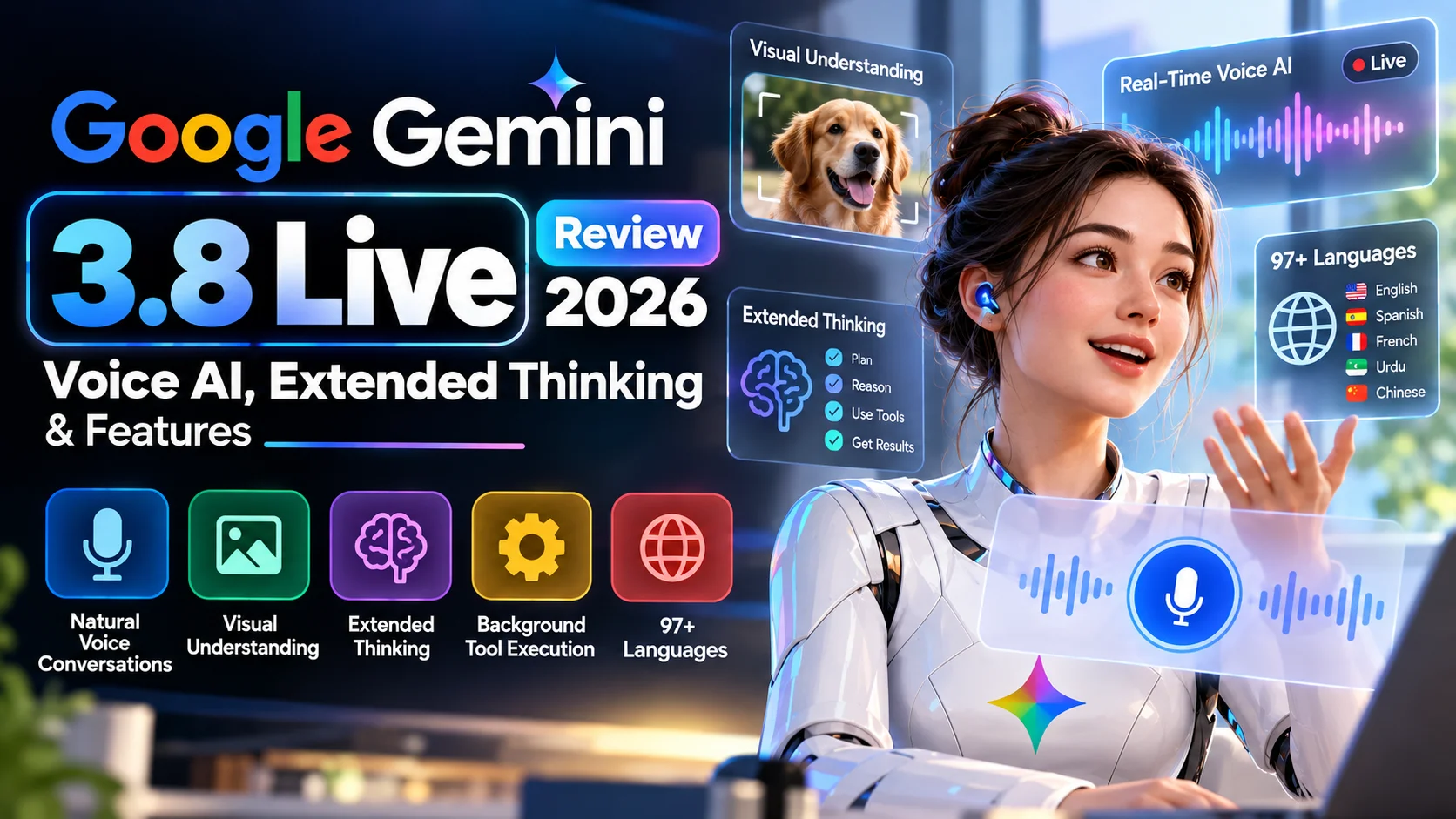
Gemini 3.8 Live Review 2026: Voice AI, Extended Thinking & Features
Google launched Gemini 3.8 Live and Gemini 3.8 Live Extended Thinking on September 15, 2026. Both models are designed for real-time audio conversations, but they target different levels of complexity.
Gemini 3.8 Live focuses on low-latency, natural voice interaction. Meanwhile, Extended Thinking adds deeper background reasoning for tasks that require planning, multiple tools, or several steps.
As a result, Google is moving Gemini beyond a simple voice assistant. The newer Live models can listen, see visual context, call tools in the background, and continue talking while work is still being completed.
This Gemini 3.8 Live review explains the main features, pricing, differences between both versions, practical use cases, and who should consider using them.
What Is Gemini 3.8 Live?
Gemini 3.8 Live is Google’s current real-time audio-to-audio model for voice agents and natural conversational applications.
Google describes it as the default choice for most low-latency voice experiences. It supports text, images, audio, and video as input, while responses can include text and audio.
The model can also use interleaved reasoning and asynchronous function calling.
That combination is important because voice agents often need to perform actions instead of simply answering questions.
For example, a customer could speak to an AI assistant and ask it to check an order. The agent could call the company’s system in the background while keeping the conversation active.
What Is Gemini 3.8 Live Extended Thinking?
Gemini 3.8 Live Extended Thinking is the higher-reasoning version of the Live model.
It is designed for situations where the agent needs to analyze information, plan several steps, or coordinate multiple tools before completing the task.
Instead of staying silent while working, Extended Thinking can provide natural progress updates during background reasoning. Google gives examples such as acknowledging a task while it searches, calculates, or waits for external tools.
Therefore, it can feel more natural than a traditional voice assistant that pauses for several seconds before responding.
Gemini 3.8 Live vs Extended Thinking
The two models are designed for different types of work.
| Feature | Gemini 3.8 Live | Gemini 3.8 Live Extended Thinking |
|---|---|---|
| Main purpose | Fast real-time conversation | Complex multi-step voice tasks |
| Reasoning | Interleaved reasoning | Background extended reasoning |
| Latency focus | Very low | Higher reasoning depth |
| Tool calls | Synchronous + asynchronous | Primarily asynchronous workflows |
| Progress updates | Limited | Natural spoken progress updates |
| Best for | Support, voice search, assistants | Booking, diagnostics, planning, tutoring |
| Thinking level | Fixed | Low, Medium, High |
Google recommends the standard Live model when immediate response speed matters most. Extended Thinking is more suitable when the agent must reason across several steps or wait for slower tools.
Real-Time Voice Conversations
The biggest advantage of Gemini 3.8 Live is its focus on natural, continuous conversation.
Users can speak normally instead of structuring every interaction as a separate prompt.
The model is designed to understand interruptions, conversational context, and the flow of a live discussion.
Furthermore, Google says Gemini 3.8 Live automatically detects and transitions between 97 supported languages during conversations.
That makes it especially interesting for international customer service and multilingual voice applications.
For readers comparing other voice platforms, our AI Voice Generator guide covers several popular AI audio tools.
Visual Understanding During Conversations
Gemini 3.8 Live is not limited to audio.
It can also process visual input in near real time.
For example, a user could show an object through a camera while asking questions about it. The model can use what it sees as additional conversational context.
This creates useful possibilities for:
- technical assistance
- employee training
- visual troubleshooting
- education
- shopping assistance
- remote support
Instead of describing everything verbally, users can show the AI what they are looking at.
Asynchronous Function Calling
One of the strongest technical improvements is asynchronous function calling.
Traditionally, when a voice agent calls an external API, the conversation may have to stop while the tool finishes.
Gemini 3.8 Live can execute certain tool calls in the background while continuing the conversation.
For example, imagine a hotel booking assistant.
A customer could ask:
“Can you check whether a room is available this weekend?”
The system could start checking the booking database while the agent continues asking about room preferences.
That creates a smoother experience because the user does not have to wait in silence.
Background Reasoning With Extended Thinking
Extended Thinking takes asynchronous work further.
Google’s implementation allows the model to continue reasoning after an utterance has finished.
The server can report whether the overall interaction is still IN_PROGRESS or has returned to IDLE.
This matters for developers because a complex voice interaction may contain several background steps.
For example, a travel agent could:
- Search flights.
- Check hotel availability.
- Compare several options.
- Calculate total prices.
- Explain the best matching options.
Throughout that process, the voice experience can remain active.
Support for AI Agents
Gemini 3.8 Live fits naturally into the growing AI agent ecosystem.
A voice agent can combine conversation with tools and external APIs to complete real tasks.
Possible examples include:
- booking appointments
- checking inventory
- handling customer support
- retrieving company information
- assisting employees
- conducting research
- performing diagnostics
If you are new to this area, our AI Agents Explained article explains how agents differ from traditional chatbots.
Gemini 3.8 Live Pricing
Google currently offers a free tier as well as paid Gemini API usage.
For Gemini 3.8 Live and Extended Thinking, Google’s current standard pricing lists:
| Usage | Paid price |
|---|---|
| Text input | $0.75 / 1M tokens |
| Audio input | $3 / 1M tokens or about $0.005/min |
| Image/video input | $1 / 1M tokens or about $0.002/min |
| Text output | $4.50 / 1M tokens |
| Audio output | $12 / 1M tokens or about $0.018/min |
Google also provides a free tier, although usage limits and data-handling conditions differ between free and paid usage.
Therefore, developers should check the current pricing page before estimating production costs.
Gemini 3.8 Live Context Window
According to Google’s model documentation, Gemini 3.8 Live supports an input token limit of 131,072 tokens and an output token limit of 65,536 tokens.
That provides substantial room for conversational context and structured information.
However, real-time audio applications can consume tokens quickly.
Developers should still manage unnecessary video frames, large prompts, and long conversations carefully.
Search Grounding
Gemini 3.8 Live also supports Google Search grounding.
This can help voice agents retrieve current information rather than relying exclusively on model knowledge.
For example, a travel assistant could use current information when answering certain questions.
However, grounding queries may have additional costs after the included monthly allowance.
Therefore, production applications should monitor both model usage and tool usage.
Alphanumeric Accuracy
Voice agents often struggle with information such as:
- booking codes
- claim numbers
- serial numbers
- account references
- product identifiers
Google specifically highlights improved alphanumeric precision as a capability of the new Gemini Audio models.
That may make Gemini 3.8 Live more practical for customer service environments where users frequently provide codes and reference numbers verbally.
Gemini 3.8 Live With Live Avatar
Google expanded the Gemini 3.8 Live family again on September 24, 2026 with Live Avatar.
The feature combines live dialogue with low-latency generated video, giving an AI agent a visual persona that can listen, see, speak, and respond in near real time.
Live Avatar can also perform asynchronous tool calls while keeping the visual conversation active.
This is especially interesting for:
- virtual customer representatives
- digital receptionists
- interactive training
- hospitality assistants
- virtual tutors
However, the feature is newer than the core Gemini 3.8 Live models, so businesses should evaluate latency, cost, and user experience before relying on it heavily.
Gemini 3.8 Live for Customer Support
Customer support is one of the clearest applications.
A Live-powered support agent could listen to a customer’s problem, retrieve information from business systems, and respond verbally.
For routine cases, this may reduce repetitive work.
Moreover, Extended Thinking could help with more complicated support issues that involve several systems or diagnostic steps.
Our Best AI Chatbots for Customer Support guide covers additional AI support tools for businesses that prefer ready-made solutions.
Gemini 3.8 Live for Booking Agents
Travel, restaurants, healthcare appointments, and hospitality all involve conversational booking workflows.
A user might request a specific date, time, location, or preference.
The agent could then call several APIs in the background while continuing the discussion.
Google has demonstrated this type of multi-step booking workflow with Gemini 3.8 Live Extended Thinking.
Therefore, voice-based booking is one of the strongest practical examples of the technology.
Gemini 3.8 Live for Education
Extended Thinking can also support interactive learning.
For example, students could speak naturally while asking about:
- mathematics
- programming
- science
- language learning
- problem solving
The model can reason about a problem and then explain the process verbally.
Google specifically lists STEM and coding tutoring among the situations where Extended Thinking can be useful.
Gemini 3.8 Live for Businesses
Businesses could use Gemini Live technology for internal assistants as well.
Potential workflows include:
- employee onboarding
- internal knowledge assistance
- sales support
- inventory lookup
- workflow guidance
- technical troubleshooting
- voice-controlled applications
However, the business value depends heavily on integration quality.
A powerful model alone does not automatically create a reliable business agent. Permissions, tool design, security, monitoring, and human escalation remain important.
Advantages of Gemini 3.8 Live
Gemini 3.8 Live combines several useful capabilities in one real-time model.
Its strongest advantages include natural voice interaction, visual context, multilingual support, asynchronous tools, and integration with Google Search grounding.
Extended Thinking adds deeper reasoning when workflows become more complicated.
In addition, the API supports developers who want to build custom voice-first experiences rather than relying only on the consumer Gemini app.
Limitations of Gemini 3.8 Live
There are still several considerations.
First, complex voice agents require significant development and testing.
Second, long audio sessions and frequent tool use can increase costs.
Third, agents connected to business systems need strict permissions.
Furthermore, voice recognition and reasoning can still make mistakes.
For important tasks, businesses should provide confirmation steps and human escalation.
Finally, Extended Thinking may not be necessary for simple conversations because the standard Live model is designed for lower latency.
Gemini 3.8 Live vs Traditional Chatbots
Traditional chatbots mainly operate through text.
Gemini 3.8 Live is designed around real-time interaction.
A user can speak naturally, show visual information, and allow the agent to call tools during the conversation.
That creates a different experience.
Instead of:
User → Question → Wait → Text Answer
the workflow becomes:
Conversation → Reasoning → Tools → Progress → Action → Spoken Result
This is one reason voice agents are becoming an important part of the broader AI agent market.
Who Should Use Gemini 3.8 Live?
Gemini 3.8 Live is most relevant for developers and companies building:
- conversational AI
- customer support agents
- booking systems
- voice assistants
- training tools
- real-time visual assistants
- multilingual applications
Extended Thinking is better suited to workflows that require multiple steps or deeper reasoning.
Meanwhile, the standard model is likely the better choice when fast conversational response is the priority.
Is Gemini 3.8 Live Worth Using in 2026?
Gemini 3.8 Live represents a significant step forward for Google’s real-time AI platform.
The standard model provides fast audio interaction, visual grounding, multilingual capability, and background tool execution. Extended Thinking adds deeper reasoning for complex tasks without abandoning the conversational experience.
For developers building modern voice agents, those capabilities make Gemini 3.8 Live worth evaluating.
Nevertheless, businesses should compare cost, latency, reliability, and integration requirements against their actual workflow.
The best model is not always the model with the most reasoning. For simple real-time conversation, lower latency can be more valuable.
Frequently Asked Questions
What is Gemini 3.8 Live?
Gemini 3.8 Live is Google’s real-time audio-to-audio AI model for low-latency voice conversations and voice agent applications. It supports text, image, audio, and video inputs.
When was Gemini 3.8 Live released?
Google released Gemini 3.8 Live and Gemini 3.8 Live Extended Thinking on September 15, 2026.
What is Gemini 3.8 Live Extended Thinking?
Extended Thinking is a version designed for complex voice tasks that need deeper reasoning, multiple steps, or slower external tools. It can continue background reasoning while keeping the conversation active.
How many languages does Gemini 3.8 Live support?
Google says Gemini 3.8 Live can automatically detect and transition between 97 supported languages during a conversation.
Does Gemini 3.8 Live support visual input?
Yes. It can use image and video input and process visual context during live conversations.
Does Gemini 3.8 Live support function calling?
Yes. Gemini 3.8 Live supports function calling, including asynchronous workflows that can allow tools to run while conversation continues.
Is Gemini 3.8 Live free?
Google currently provides a free API tier, while paid usage is charged according to text, audio, image/video, and output consumption.
Conclusion
The Gemini 3.8 Live family shows how quickly voice AI is moving toward practical AI agents.
Standard Gemini 3.8 Live focuses on fast, natural dialogue. Meanwhile, Extended Thinking handles more demanding workflows through background reasoning and asynchronous tools.
Visual context, multilingual support, function calling, and the newer Live Avatar feature make the platform suitable for much more than simple voice chat.
For developers building customer support, booking systems, education tools, or conversational business applications, Gemini 3.8 Live is one of the important voice AI platforms to evaluate in 2026.

