


Customer support has become one of the most practical applications of artificial intelligence.
Instead of forcing customers to wait for an available human agent, modern AI support systems can understand questions, search approved company knowledge, provide answers, perform certain actions, and escalate conversations when human help is required.
However, today’s best AI chatbots for customer support are no longer simple FAQ bots.
Many have evolved into AI agents that can reason through support problems, use customer context, interact with business systems, and complete multi-step support tasks.
Therefore, choosing the right platform requires looking beyond whether it can simply “chat.”
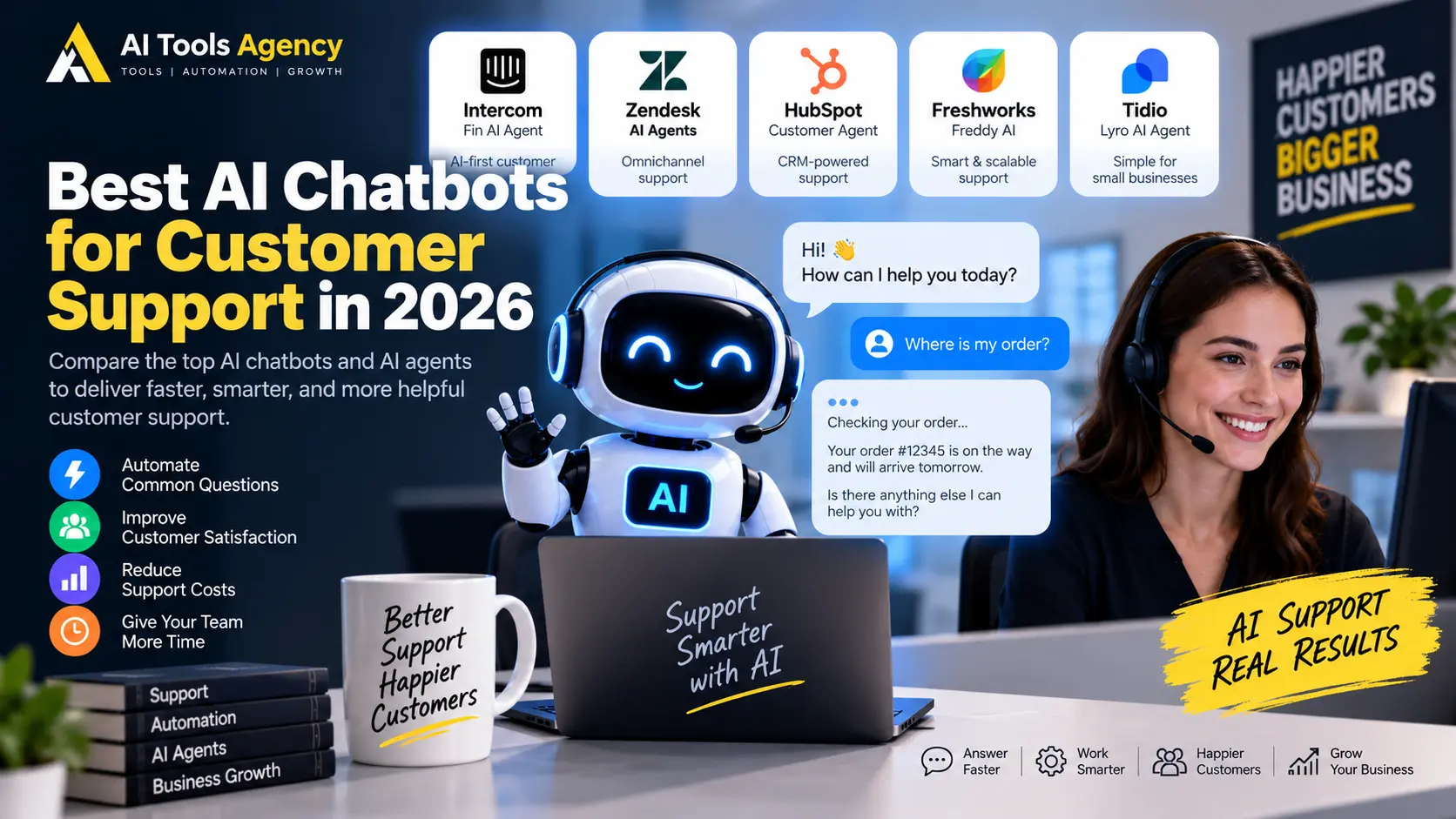
In this guide, we compare five strong customer-support AI platforms available in 2026:
Intercom Fin, Zendesk AI Agents, HubSpot Customer Agent, Freshworks Freddy AI Agent, and Tidio Lyro.
If you want to understand the technology behind these systems first, read our AI Agents Explained guide.
Best AI Chatbots for Customer Support: Quick Comparison
| Platform | Strong Fit For | AI Pricing Model |
| Intercom Fin | AI-first support teams and existing helpdesks | From $0.99 per outcome |
| Zendesk AI Agents | Businesses already using Zendesk or needing mature omnichannel support | Automated-resolution / outcome based |
| HubSpot Customer Agent | CRM-centered sales and service teams | $0.50 per successful resolution |
| Freshworks Freddy AI Agent | Freshdesk/Freshchat users and growing support teams | Session-based |
| Tidio Lyro | Small businesses, e-commerce and simpler deployments | Conversation-based |
Prices and plan structures can change, so always confirm current pricing before purchasing.
1. Intercom Fin AI Agent
Intercom Fin is one of the most prominent AI agents built specifically for customer-facing conversations.
Instead of operating only as a scripted chatbot, Fin can answer customer questions from company knowledge, execute configured procedures, interact with external systems, and hand conversations to human agents when necessary.
Intercom currently sells Fin both as part of the Intercom customer-service platform and as an AI agent that can work with an existing helpdesk. Its documentation says Fin can operate across channels including chat and email, while Intercom also offers broader phone capabilities.
How Fin Works
A simple Fin support workflow might look like this:
Customer asks a question
↓
Fin identifies the issue
↓
Searches approved support knowledge
↓
Provides answer or performs procedure
↓
Checks whether issue is resolved
↓
Hands off to human if necessary
Intercom also measures an automation rate, which represents the percentage of support conversations Fin resolves without a human teammate stepping in.
This makes the platform particularly relevant for businesses that want AI to handle a measurable portion of incoming support volume.
Fin Pricing
As of September 2026, Intercom’s Essential plan is listed at $29 per seat/month when billed annually, with Fin starting at $0.99 per outcome. Fin can also be purchased for an existing helpdesk without Intercom seats, although minimum commitments apply.
Intercom counts successful outcomes such as resolutions and configured procedure handoffs, rather than simply charging for every AI message.
Good Fit For
Fin is particularly relevant for businesses that want:
- AI-first customer support;
- knowledge-based answers;
- human handoff;
- procedure execution;
- integration with an existing support stack;
- outcome-based AI usage.
However, companies should calculate expected support volume carefully because outcome-based pricing can become significant at scale.
2. Zendesk AI Agents
Zendesk has moved aggressively from traditional support bots toward more autonomous AI agents.
In 2026, Zendesk expanded advanced agentic capabilities across its customer-service offering. Its current direction centers on AI agents that can reason, adapt, take action, and work alongside human support teams.
Zendesk’s AI agents can interact with customers across messaging and email-based channels, while its broader platform supports web, mobile, social, voice, and email customer experiences.
Why Zendesk Is Important for Customer Support
Zendesk is not only an AI chatbot.
It is a complete support environment combining elements such as:
ticketing, routing, knowledge, automation, human agents, reporting, messaging, AI agents, and customer context.
Therefore, businesses already using Zendesk may find it easier to introduce AI inside their existing service operation rather than deploy a separate chatbot platform.
For example:
Customer Request
↓
Zendesk AI Agent
↓
Understand Issue
↓
Search Knowledge
↓
Take Approved Action
↓
Resolved?
↓
YES → Close
NO → Human Agent
Zendesk Pricing
Zendesk’s current pricing page lists Suite Team at $55 per agent/month when paid annually, while Suite Professional is listed at $115 per agent/month. AI agents are included across Zendesk Suite and Support plans, with AI usage measured through successful automated resolutions and plan-specific allowances.
Therefore, the final cost can depend on both seats and AI resolution usage.
Good Fit For
Zendesk can make sense for:
- established support teams;
- companies already using Zendesk;
- multi-channel support operations;
- organizations requiring ticketing and routing;
- teams that need AI integrated with a mature helpdesk.
In addition, its combination of AI agents and human support workflows makes it suitable for organizations where AI should handle routine issues but not operate completely independently.
3. HubSpot Customer Agent
HubSpot’s Customer Agent is especially interesting for businesses already using HubSpot CRM.
Instead of treating the chatbot as an isolated support widget, HubSpot can use broader customer context such as CRM information, knowledge-base content, and conversation history.
HubSpot’s 2026 updates describe Customer Agent as being powered by knowledge and customer context, with support for email and configurable rollout controls.
That CRM integration can be valuable.
For example, imagine a customer asks:
“Why hasn’t my subscription changed after I upgraded?”
A customer-support AI system with CRM context may be able to understand not only the question but also relevant account information.
HubSpot Customer Agent Workflow
A possible process could be:
Customer asks question
↓
Customer Agent checks knowledge
↓
Uses CRM/customer context
↓
Provides answer
↓
Needs additional help?
↓
Escalate to human
HubSpot also allows teams to control how and where the Customer Agent is deployed.
This can help companies introduce automation gradually instead of sending every customer conversation to AI immediately.
HubSpot Customer Agent Pricing
HubSpot states that Customer Agent can be tried for 28 days and currently charges $0.50 per successful resolution. Access also depends on eligible Professional or Enterprise Hub subscriptions and HubSpot Credits.
Good Fit For
HubSpot Customer Agent is worth considering when a business already relies heavily on:
- HubSpot CRM;
- Service Hub;
- marketing and sales data;
- HubSpot knowledge content;
- unified customer records.
As a result, businesses can potentially keep sales, marketing, customer data, and support automation inside one ecosystem.
4. Freshworks Freddy AI Agent
Freshworks provides Freddy AI Agent across its customer-service products.
The system is designed to answer support questions, interact with knowledge sources, and automate customer-service conversations.
Freshworks currently promotes AI agents capable of handling chat, messaging, and email support, while its Freshdesk Omni offering includes AI Agent Studio for building, testing, deploying, and monitoring agents.
In addition, Freshworks supports agentic workflows with integrations for services such as Shopify, Stripe, PayPal, and Wix.
Freddy AI Agent Example
Consider an e-commerce customer asking:
“My package says delivered, but I didn’t receive it.”
A configured AI support process could potentially:
Understand delivery issue
↓
Check approved order information
↓
Follow company delivery procedure
↓
Provide next steps
↓
Escalate unusual case
The useful part is not simply producing a conversational answer.
Instead, the value comes from combining customer interaction with business procedures.
Freddy AI Agent Pricing
Freshworks currently states that qualifying packages include the first 500 AI Agent sessions, with additional packs priced at $49 per 100 sessions. A session covers interactions occurring within a 24-hour window.
Because pricing is based on sessions rather than simply individual messages, businesses should estimate monthly conversation volume before choosing a plan.
Good Fit For
Freddy AI Agent may suit:
- Freshdesk users;
- Freshchat users;
- growing support teams;
- e-commerce businesses;
- companies wanting AI and human support in the Freshworks ecosystem.
5. Tidio Lyro AI Agent
Tidio Lyro is particularly useful for small and medium-sized businesses that want to introduce AI-powered customer support without building a complex enterprise setup.
The platform combines live chat, ticketing, automation flows, and its Lyro AI Agent. As a result, businesses can manage both automated and human customer conversations from one environment.
Lyro uses approved support content to answer customer questions. In addition, businesses can monitor its performance and improve response quality by expanding or updating their knowledge base.
Another useful option is Lyro Connect, which allows companies to integrate Lyro with an existing support environment. Therefore, businesses do not necessarily need to replace their current helpdesk.
Lyro uses support content to answer customer questions, and Tidio says businesses can monitor its performance and improve responses by adding better knowledge.
Moreover, Lyro can also be connected to an existing support environment through Lyro Connect rather than requiring every company to replace its current helpdesk.
Why Lyro Is Attractive for Smaller Businesses
Small businesses often do not need a large enterprise customer-service platform.
Instead, many simply need an AI system that can answer common questions quickly and transfer more complicated conversations to a human.
For example, a typical workflow might look like this:
Website visitor
↓
Asks a question
↓
AI answers from business knowledge
↓
Issue resolved
OR
Human takes over
Because of this simple approach, Lyro can be easier to evaluate for businesses dealing mainly with website chat, e-commerce questions, leads, and routine customer inquiries.
Moreover, Tidio introduced proactive Lyro capabilities in 2026. These allow configured triggers to begin AI conversations rather than always waiting for the customer to start first.
Tidio Lyro Pricing
Tidio currently lists standalone Lyro AI Agent pricing starting at around $32.50 per month, with an initial allowance of 50 Lyro conversations.
In addition, its broader Starter customer-service plan is listed from $24.17 per month with annual billing. However, businesses should confirm current pricing before subscribing because plans and usage allowances can change.
Good Fit For
Lyro may be particularly suitable for:
- small businesses;
- online stores;
- service businesses;
- teams with lower support volume;
- companies looking for a relatively accessible AI support deployment.
Which AI Chatbot Is Best for a Small Business?
Small businesses should avoid selecting a platform simply because it has the largest feature list.
Instead, consider your actual support environment.
If most customers contact you through your website and your support needs are relatively straightforward, Tidio Lyro may provide a simpler starting point.
Meanwhile, businesses already using HubSpot may benefit more from Customer Agent because the customer context is already inside the CRM.
Intercom Fin can make sense when AI-first customer service is a major objective.
On the other hand, Zendesk and Freshworks become particularly relevant when a business needs a more complete helpdesk environment.
Therefore, the best platform depends heavily on your existing software and support volume.
AI Chatbots vs AI Customer Service Agents
The term chatbot is still widely used, but modern platforms increasingly describe their products as AI agents.
A traditional chatbot may answer:
Customer: What is your refund policy?
Bot: Our refund policy allows…
An AI customer-service agent may potentially do more:
Customer requests refund
↓
Understand reason
↓
Check order
↓
Verify policy
↓
Determine next permitted step
↓
Take approved action or escalate
This difference is important.
If you want a deeper explanation, see our guide:
AI Agents Explained: What They Are & How They Work
What Features Should a Customer Support AI Chatbot Have?
A strong customer-support system should do more than generate natural-sounding replies.
Important capabilities include:
Reliable knowledge grounding. The AI should answer from approved company information rather than inventing policies.
Human handoff. When the AI cannot solve a problem confidently, transferring the customer should be easy.
Customer context. Access to appropriate account or CRM context can improve responses.
Action capabilities. More advanced systems may update records, check orders, run procedures, or trigger workflows.
Analytics. Businesses should know what the AI resolves, where it fails, and which questions frequently require human intervention.
Permission controls. AI should only receive the access required for its assigned job.
Multiple channels. Depending on the business, support may arrive through chat, email, social channels, messaging apps, or voice.
Knowledge Quality Matters More Than the Chatbot Interface
A customer-support AI agent is only as useful as the information available to it.
Suppose your documentation contains outdated pricing.
The chatbot may provide outdated pricing.
Likewise, if refund policies are unclear, the AI may struggle to answer refund questions reliably.
Therefore, before deploying customer-service AI, businesses should improve:
Help Center
FAQs
Product Documentation
Policies
Troubleshooting Guides
Support Procedures
Customer Data Quality
Better knowledge improves both human and AI support.
Human Handoff Is Essential
A useful AI chatbot should know when to stop.
For example, an AI agent may successfully handle:
- password-reset instructions;
- product information;
- order-status questions;
- common setup problems;
- basic billing explanations.
However, a person may need to handle:
- sensitive complaints;
- unusual refunds;
- legal disputes;
- security issues;
- high-value customers;
- complex technical problems.
Therefore, a good support workflow might look like:
Customer Message
↓
AI Attempts Resolution
↓
Confidence / Procedure Check
↓
Can AI safely resolve?
↓
YES → Complete
NO → Human Support
Automation should reduce unnecessary human workload without creating unnecessary customer frustration.
AI Chatbots for E-Commerce
E-commerce support is an especially strong use case because many questions repeat.
Customers frequently ask about:
- delivery;
- refunds;
- returns;
- product availability;
- sizing;
- account information;
- order status.
An AI system connected to approved store data can answer many of these questions instantly.
However, integrations matter.
An e-commerce company should check whether its preferred support platform connects with systems such as Shopify, payment processors, order-management software, and shipping tools.
AI Chatbots for SaaS Companies
Software companies often receive repetitive technical questions.
For example:
How do I invite another user?
Where can I change billing?
Why is my integration disconnected?
How do I export my data?
A support AI agent can use product documentation to answer these questions.
Furthermore, more advanced agents can potentially inspect approved account information or trigger predefined procedures.
This can reduce first-response time while allowing human technical staff to focus on more complicated issues.
AI Chatbots for Service Businesses
Service businesses can also use customer-support AI.
For example, an agency could use an AI chatbot to handle:
Service questions
↓
Pricing guidance
↓
Project qualification
↓
Appointment request
↓
Human sales handoff
The chatbot can answer simple inquiries while routing valuable opportunities to the right person.
However, do not allow AI to make binding quotations or promises unless the workflow has been carefully designed.
Customer Support AI and Workflow Automation
AI chatbots become more valuable when connected to workflow automation.
For example:
Customer reports billing issue
↓
AI categorizes request
↓
Automation checks CRM
↓
AI prepares response
↓
Support team notified
↓
Human approves if necessary
This is where AI customer support begins to overlap with broader business automation.
For practical examples, see our guide on how to automate repetitive business tasks with AI.
You can also explore our comparison of the best AI automation tools for small businesses.
How to Choose the Best AI Chatbot for Customer Support
Before selecting a platform, evaluate your business based on one practical question:
Where does customer support already happen?
If your team already works inside Zendesk, introducing Zendesk AI may be easier than migrating the entire operation.
Likewise, a HubSpot-centered business may gain more value from Customer Agent because customer records already live there.
A small e-commerce store may prefer the simplicity of Tidio.
Meanwhile, an organization specifically pursuing AI-first support may prefer a platform such as Intercom Fin.
Also consider monthly conversation volume.
A platform that appears inexpensive at low usage may become considerably more expensive when thousands of AI resolutions occur every month.
Therefore, estimate your real support volume before subscribing.
Do AI Chatbots Replace Customer Support Agents?
In most businesses, the more useful goal is not complete replacement.
Instead, AI can divide support work more intelligently.
For example:
AI:
Routine questions
Simple troubleshooting
Knowledge retrieval
Ticket classification
Basic account guidance
Humans:
Complex problems
Sensitive complaints
Negotiations
Exceptions
High-risk decisions
Relationship management
As a result, human agents can spend more time on conversations where judgment and empathy matter most.
Common Mistakes When Deploying AI Customer Support
Businesses often focus too much on launching quickly.
A safer rollout avoids:
- connecting poor-quality knowledge;
- allowing unrestricted actions;
- hiding human support completely;
- failing to monitor conversations;
- ignoring customer feedback;
- automating sensitive decisions;
- launching across all customers immediately.
Start with a limited set of support questions.
Measure performance.
Improve knowledge.
Then gradually allow the AI to handle more.
HubSpot, for example, now provides rollout controls that allow teams to scale deployment progressively.
FAQ
What are the best AI chatbots for customer support in 2026?
Strong current options include Intercom Fin, Zendesk AI Agents, HubSpot Customer Agent, Freshworks Freddy AI Agent, and Tidio Lyro. The right option depends on your helpdesk, CRM, support volume, integrations, and budget.
Which AI chatbot is good for small businesses?
Tidio Lyro and Intercom’s smaller-team offering are worth evaluating for smaller businesses. However, businesses already using HubSpot, Zendesk, or Freshworks may gain more value by using the AI capabilities inside their existing platform.
Can AI chatbots answer customer emails?
Yes, several modern customer-service agents support email. Zendesk AI agents can operate on email channels, HubSpot added email support for Customer Agent, and Freshworks offers an Email AI Agent.
Can an AI chatbot transfer customers to humans?
Yes. Human escalation is a core capability of many modern support platforms, including Intercom Fin and Tidio Lyro.
Are customer-support AI chatbots expensive?
Pricing varies significantly. Some vendors charge per seat plus AI usage, while others charge per resolution, outcome, session, or conversation. Therefore, compare pricing using your expected monthly support volume rather than only the advertised starting price.
Can AI customer service agents make mistakes?
Yes. They can misunderstand questions, rely on outdated knowledge, or choose an incorrect action. Businesses should use monitoring, high-quality knowledge, restricted permissions, and human escalation.
Final Thoughts
The best AI chatbots for customer support in 2026 are evolving into something much more capable than traditional website bots.
Intercom Fin focuses heavily on AI-first customer service and outcome-based automation.
Zendesk combines AI agents with a mature helpdesk and omnichannel support environment.
HubSpot Customer Agent stands out for businesses where CRM context is central to customer service.
Freshworks Freddy AI Agent provides agentic support within the Freshworks ecosystem.
Meanwhile, Tidio Lyro offers an accessible option for smaller businesses and e-commerce teams.
The right choice depends on your existing tools, support channels, customer volume, required integrations, and how much autonomy you want to give AI.
Most importantly, build the system around resolution quality, not simply automation percentage.
AI should make customer service faster and more useful—not merely make it more automated.
For more AI resources, visit our AI Tools hub.

