


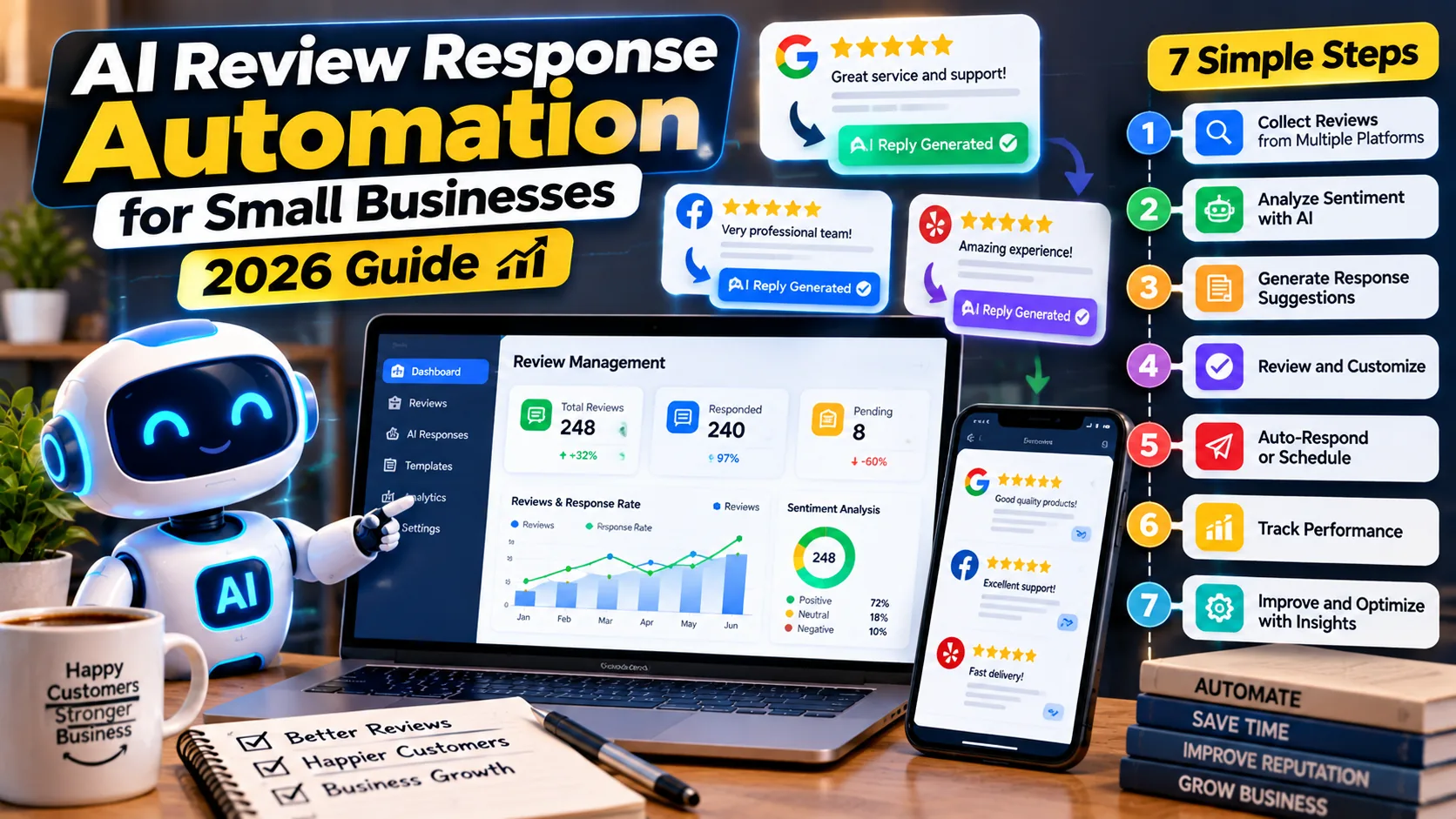
AI review response automation can help a small business answer customer feedback sooner without sending the same generic message to every reviewer. Yet a good response requires more than fluent wording. It needs verified facts, a respectful tone, and an appropriate route for sensitive complaints.
This 2026 guide shows how to build a seven-step review-reply workflow for platforms that permit business responses. The goal is to use AI for drafting and triage while preserving customer privacy, honest reviews, and human accountability.
What is AI review response automation?
The workflow collects reviews from approved channels, classifies their intent, proposes replies, routes them for review, and records what was posted. AI helps with language; people remain responsible for decisions and service recovery.
This task is different from AI customer feedback analysis, which looks at patterns across many responses. Here, a customer sees an individual public reply, so unsupported claims and private information are especially risky.
7 steps for safe and helpful review replies
Begin with a limited workflow and a published customer-support policy. Then expand gradually as you learn which kinds of comments require a manager.
1. Collect reviews through authorized channels
First, list your active review locations and the employees responsible for each. For example, a retailer might monitor Google Business Profile and its own store reviews. Collect the review text, date, rating, source link, relevant branch, and language where the platform permits it.
Avoid collecting more personal data than necessary. Google’s Business Profile help explains the public review-reply workflow and the need for a verified profile to respond.
2. Sort issues by urgency and subject
Next, classify feedback into appreciation, service suggestion, product question, delivery issue, billing dispute, and urgent concern. A low star rating does not always mean a crisis, while a positive review could still mention a safety problem.
Therefore, use explicit escalation rules. Allegations of misconduct, safety risks, threats, and sensitive financial complaints should reach a responsible person quickly instead of entering a routine response queue.
3. Create an approved fact and tone guide
Prepare a short reference sheet containing accurate hours, support channels, basic policies, escalation ownership, and the style of public replies. If refund eligibility requires a transaction review, the tool must not promise that money has already been returned.
In addition, explain what the assistant must never say: invented facts, accusations about a reviewer, unrelated sales offers, or personal details. A reliable policy matters more than a long list of creative prompts.
4. Generate a concise, specific draft
Provide the original review and the approved facts. Then ask for a reply that acknowledges the specific experience and suggests only a verified next step. Avoid identical “we value your feedback” messages when the reviewer has raised a concrete issue.
Sample prompt: “Write a public reply of 40–75 words to this review. Use a warm, professional tone and only the approved business facts below. Do not reveal personal details, invent compensation, accuse the reviewer, or suggest that an investigation is already complete. Flag serious complaints for human review.”
5. Protect privacy and avoid false promises
A customer may share a transaction number or a sensitive story. Do not repeat those details publicly. Instead, provide a legitimate private channel for verification and explain what the team can do next.
Also, avoid fabricating testimonials or pressuring customers to change authentic feedback. The FTC consumer-review guidance addresses deceptive reviews and certain forms of coercion in the United States. Businesses in other places must check local rules and platform policies.
6. Use human approval and a clear audit trail
During a pilot, have a person approve every reply. Later, the business can evaluate whether simple acknowledgments may use a lighter process. Nevertheless, keep mandatory review for disputes, allegations, urgent problems, or anything involving compensation.
Record the source review, draft version, reviewer, posting time, and any subsequent edit. This makes it possible to correct an error quickly and understand why a particular answer appeared.
7. Measure whether problems are actually resolved
Finally, monitor response delays, corrections required, unresolved complaints, repeat issues, and how many reviews lead to a useful service follow-up. A short reply time is not valuable when the underlying customer problem remains unsolved.
Share common themes with operations. For instance, if many reviews mention confusing opening hours, update the business listing and customer communications rather than drafting endless apologies.
Examples: different replies for different situations
Imagine a customer writes that the food was good but pickup was slower than expected. An appropriate reply could thank them for the compliment, acknowledge the delay without inventing an excuse, and offer a verified contact channel for more information.
In contrast, a review alleging a serious safety incident should be escalated before a public reply is approved. A public comment must not expose health information, blame an employee, or make unsupported factual determinations.
| Review type | Drafting approach | Approval priority |
|---|---|---|
| Specific praise | Thank and reflect the real detail | Standard |
| Question about a policy | Reference an approved current policy | Standard |
| Delivery or service problem | Acknowledge and route privately | Review before posting |
| Refund dispute | Do not promise unapproved action | Manager |
| Safety or legal allegation | Escalate before composing a public reply | Urgent |
Common mistakes that harm customer trust
Avoid the temptation to turn every review into an advertisement. Repeated promotion can make even a sincere thank-you sound insincere. Similarly, templated apologies that ignore a specific problem tell customers that nobody read their words.
Never submit fake AI-generated reviews as customer experiences. Do not buy a positive rating, suppress genuine negative feedback through intimidation, or condition compensation on a changed review. Respectful customer service is the objective, not manipulation.
A two-week pilot for one business location
Start with a manageable sample and clear escalation criteria. A small café might review ten to twenty real, authorized past comments to test draft quality without posting the results automatically.
- Days 1–3: define review categories, owner roles, and privacy restrictions.
- Days 4–6: build the approved information sheet and draft templates.
- Days 7–10: compare AI suggestions with staff-written replies; review each draft manually.
- Days 11–14: measure mistakes, response time, and real service follow-up; improve the policy.
How this connects to wider customer service
AI review replies are only one communication channel. A customer might need an order update, a replacement, or a support ticket after the public exchange. Therefore, connect the review process to existing team ownership rather than letting it become a separate inbox.
For wider use cases, see our AI customer service bot guide and AI agent security checklist. Permissions to publish public messages should be limited and auditable.
Frequently asked questions
Can AI reply to every Google review automatically?
A connected tool may support some review workflows, but available features and policies vary. Human approval is safest during setup, especially for disputes and sensitive comments.
Should I respond to negative reviews?
Respond when you can acknowledge a concern constructively. Stay factual and respectful; avoid arguing with the reviewer or disclosing private records.
Can a business offer a discount to improve its rating?
Do not make incentives contingent on a positive review, editing a rating, or removing honest criticism. Check the rules that apply to your platform and location.
How do I avoid robotic AI replies?
Acknowledge the reviewer’s actual concern, keep the response brief, vary wording, and require a person to verify the facts.
Final takeaway
Useful AI review response automation is an accountable customer-support workflow. AI can help draft and prioritize messages, but the business must protect private information, preserve genuine feedback, and solve operational problems. Start small, review outcomes, and expand only when the process earns trust.

