


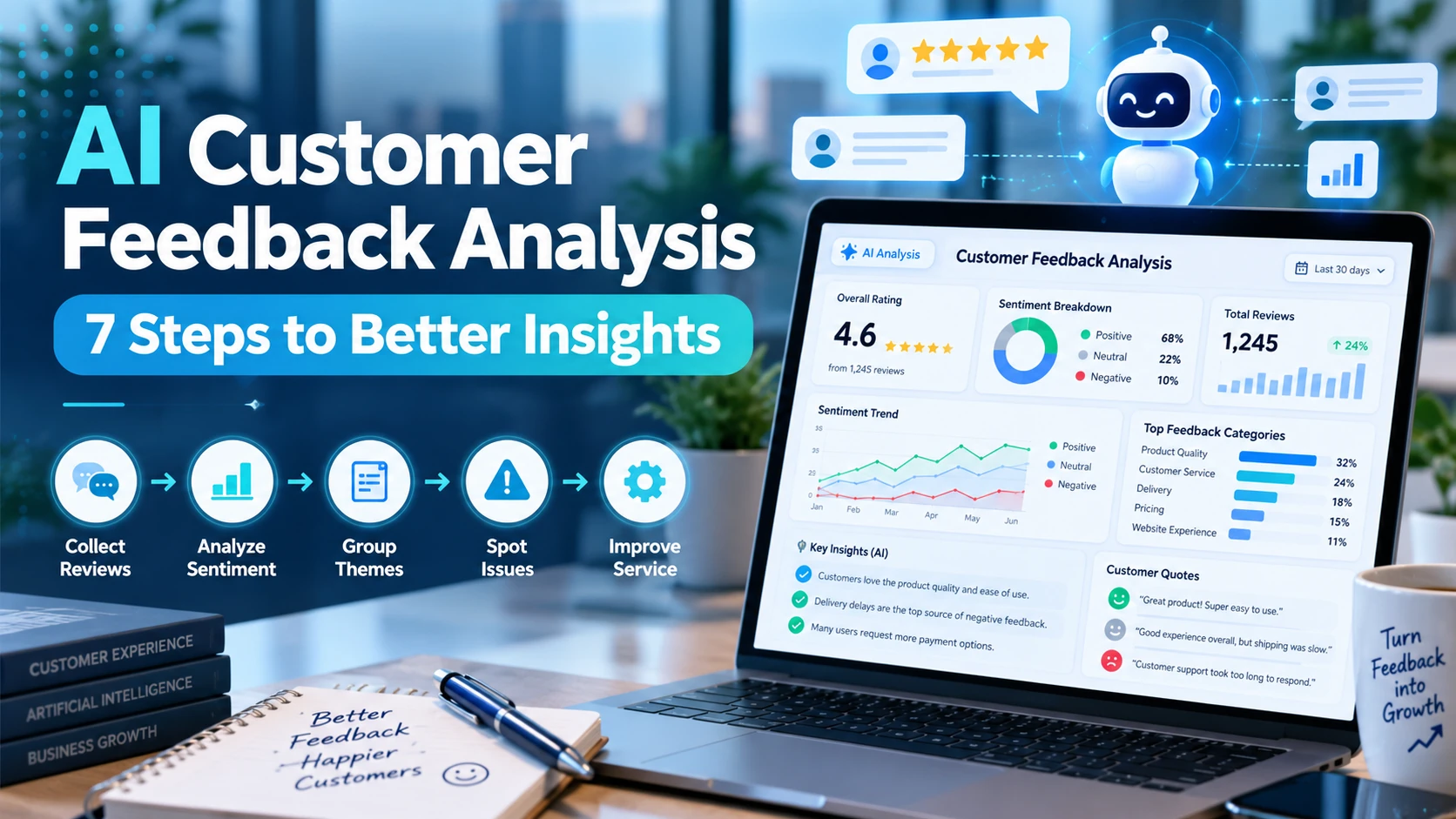
A business can receive hundreds of reviews, survey comments, support messages, and social mentions without gaining a clear picture of what customers want. A five-star average hides recurring complaints about delivery; a support dashboard shows ticket counts but not the themes behind them. AI customer feedback analysis helps sort the text into topics, sentiment, and patterns so a team can decide where to investigate.
The goal is not to turn every comment into a magic satisfaction score. Instead, the goal is to connect what customers actually said with evidence, ownership, and a measurable improvement. Here is a practical framework for 2026, designed for teams that want useful insights without losing the context behind individual comments.
What is AI customer feedback analysis?
AI customer feedback analysis uses natural language processing and related tools to organize unstructured customer language. Depending on the system, it can identify common topics, detect sentiment, group similar complaints, summarize long conversations, and highlight trends by product, location, or time period.
For example, 80 reviews may mention “checkout,” but only some refer to broken payment links. A useful analysis separates “checkout speed,” “payment declined,” and “confusing shipping fees” into distinct issues. It also preserves representative comments so a manager can understand the cause before acting.
Traditional keyword search is still useful. However, AI becomes valuable when customers describe the same problem in many ways, when feedback spans several channels, or when the team needs consistent categories across a large volume of comments. Neither method replaces listening to customers directly.
Start with a question, not a dashboard
Before connecting a tool, decide which decision the analysis should support. For example, a retailer may want to reduce returns, while a restaurant may need to investigate slow delivery complaints. Meanwhile, a software company could prioritize onboarding improvements, and a service agency might explore why customers cancel.
A strong question is specific: “Which three issues account for most complaints from first-time customers this month?” By contrast, a weaker question is “What does AI think of our reviews?” The first can lead to a named owner and a test. The second may produce attractive charts with no practical next step.
Next, write down a baseline, a review period, the audience segment, and a decision deadline. This makes it easier to notice whether an intervention actually helped.
The six types of insights worth extracting
1. Topic frequency
Group messages into categories such as pricing, quality, delivery, support, billing, onboarding, and returns. Use product-specific subtopics when helpful. Review a sample manually to catch merged categories: “late refund” should not automatically count as “late delivery.”
However, frequency is not the same as severity. An issue reported by only three customers may be serious if it involves safety, privacy, or failed payments. Add a separate urgency field and an escalation route.
2. Sentiment and emotional tone
Sentiment analysis usually assigns labels such as positive, neutral, or negative, sometimes with confidence scores. However, a message can praise the product and criticize the service in the same sentence. A single overall label loses that difference.
Microsoft’s documentation describes opinion mining, which links sentiment to particular aspects of a sentence. For instance, a customer can like the food while criticizing a slow delivery. This aspect-level approach is often more actionable than an overall mood score. See the technical explanation of sentiment and opinion mining.
Important 2026 product-planning note: Microsoft has announced that its Azure Language sentiment analysis and opinion mining features are scheduled to retire in March 2029, with migration guidance toward Foundry models. Verify the current recommended service before building a new long-term integration.
3. Emerging issues
Compare topics week by week. A sudden rise in “damaged package” comments might follow a change in packaging or shipping carrier. A smaller spike can be worth investigating if the same phrase appears across independent customers.
Still, inspect the underlying volume and channel mix. A promotion that doubles total reviews can also double complaint counts while leaving the complaint rate unchanged. When possible, use rates per order, per ticket, or per active customer rather than raw mentions alone.
4. Customer journey stage
Tag each comment to its likely stage: discovery, purchase, delivery, onboarding, ongoing use, support, or cancellation. This helps distinguish a marketing promise problem from a fulfillment problem.
For example, “I expected next-day delivery” could indicate misleading website copy, an unavailable shipping option, or a misunderstanding at checkout. Journey mapping gives the owner a starting point for investigation; it should not be treated as an automatic finding of fault.
5. Root-cause clues
AI can suggest links among phrases, dates, products, and process changes, but it cannot prove the cause. A recurring complaint about an app update may correlate with a bug; engineering must confirm the bug with logs or reproduction steps. Preserve a distinction between observed evidence, plausible hypothesis, and confirmed root cause.
6. Opportunities, not only problems
In addition, positive comments can identify what customers value most. If buyers repeatedly praise clear setup instructions, consider highlighting that benefit in onboarding and marketing. If customers request a missing integration, measure demand among your target segments before making it a roadmap priority.
A seven-step workflow for analyzing customer feedback
Step 1: Gather data with permission
Bring together approved sources: post-purchase surveys, public reviews, support tickets, chat transcripts, and account cancellation reasons. Respect each platform’s terms. Do not scrape restricted customer data or assume that a public review grants permission to merge it with identifiable private support records.
For each entry, keep a timestamp, channel, product, country or language when available, and a pseudonymous identifier if necessary. Remove unrelated personal information before sending the text to a third-party AI service.
Step 2: Normalize the dataset
Next, deduplicate copied comments, remove obvious spam, and define a consistent schema. Keep the unedited original in a protected system while creating a working text field for analysis. Separate a support agent’s reply from the customer’s words so the model does not mistake the reply for feedback.
Additionally, if comments include more than one language, record the language rather than automatically translating everything without review. Idioms, sarcasm, and local expressions can change meaning in translation.
Step 3: Build a manageable taxonomy
Start with roughly six to ten broad themes and clear subtopics. Create definitions and examples, including “other/unclear.” Decide whether one comment may have multiple labels. A message about a late order and rude support should usually be eligible for two topics.
However, do not allow the taxonomy to expand endlessly. Review new labels weekly, merge duplicates carefully, and preserve a mapping so historical trends remain comparable.
Step 4: Analyze with AI, then sample-check
Then, ask the model or specialist tool to return structured fields: topic, secondary topic, aspect sentiment, urgency, evidence quote, and uncertainty. Set an explicit instruction not to invent details missing from the original comment.
Afterward, have a reviewer check a stratified sample: positive, negative, neutral, multilingual, long, short, and low-confidence cases. Count misclassifications. A tool that sounds impressive on a few demos may perform poorly on your particular vocabulary.
Step 5: Build a useful report
A weekly report could show the five fastest-growing issues, volumes and denominators, representative anonymized comments, affected products, confidence limitations, and the assigned owner. Link every theme back to a sample of source records.
A concise executive summary is useful only if it includes what changed and what should happen next. Avoid turning speculative AI summaries into corporate facts.
Step 6: Assign action and communicate
For each priority issue, assign a specific team, a working hypothesis, a target date, and a proposed fix. Example: “Checkout errors reported by mobile buyers increased after a release; product team will reproduce the issue and compare the failed-payment rate before deciding whether to roll back.”
Where appropriate, acknowledge affected customers rather than using internal analytics as a substitute for support. An AI customer service bot can assist with triage, but escalation and fair resolution still need human ownership.
Step 7: Measure the result
After the fix, track the original issue rate, adjusted for seasonality and total volume. Compare related outcomes such as repeat purchases, ticket reopenings, or refund requests where your systems permit. Keep a feedback loop to update the taxonomy as the business changes.
A sample feedback-analysis table
The following rows are illustrative, not real customer data or measured results.
| Customer comment | Theme | Aspect sentiment | Next step |
|---|---|---|---|
| “The product is great, but delivery arrived two days late.” | Shipping time | Negative for delivery; positive for product | Check carrier performance |
| “Setup was easy and support answered quickly.” | Onboarding and support | Positive | Preserve the onboarding pattern |
| “I was charged twice and cannot find a refund form.” | Billing and refunds | Negative, high priority | Escalate billing incident |
| “It works, but I wish it exported to CSV.” | Missing feature | Neutral/mixed | Quantify export requests |
This is why aspect-based labels and a next action are often better than a single positive/negative column.
Tools and deployment choices
A lightweight workflow can begin with a spreadsheet and an approved AI assistant used on redacted comments. A growing organization may prefer customer-experience software, a helpdesk integration, or an NLP API that returns structured outputs. A large enterprise may require data warehouse integration, regional processing, custom taxonomies, and role-based controls.
| Setup | Suitable situation | Key consideration |
|---|---|---|
| Spreadsheet with manual tagging | Small review volume | Consistency and review time |
| AI assistant with protected sample data | Exploratory theme discovery | Privacy and output verification |
| Support or survey platform analytics | Existing customer-support workflow | Export capability and label quality |
| NLP API and custom dashboard | Multiple channels and unique taxonomy | Engineering, security, monitoring |
Do not choose software because it promises a high number of “AI insights.” Compare how clearly it shows original comments, confidence, segment filters, corrections, and change history. Recheck current pricing and product availability on each provider’s official site.
Useful metrics—and misleading ones
Issue rate: Number of orders or customers reporting an issue divided by the relevant orders or customers. Topic share: Percentage of feedback entries mentioning a theme. Time to resolution: Median time between a confirmed issue and its resolution. Classification agreement: How often a model’s label matches reviewed human labels.
Keep these measurements separate. Topic share is not the same as complaint incidence across your whole customer base because only some customers leave feedback. A sentiment score does not equal customer satisfaction, Net Promoter Score, revenue, or retention.
Also, consider participation bias. Customers with unusually positive or negative experiences may be more likely to post. Customers from certain languages, regions, or platforms may be underrepresented. Reporting that limitation makes the findings more useful, not less.
Risks and quality checks
Sarcasm and mixed sentiment: “Fantastic, another broken update” is not genuine praise. Use original examples in manual evaluation.
Sensitive information: Redact payment details, health information, phone numbers, addresses, and identifying data unless there is a justified, permitted need. Apply retention rules and role-based permissions.
Fake or coordinated reviews: Automated clustering cannot establish authenticity. Investigate anomalies and follow platform policies instead of making unsupported accusations.
Unfair segmentation: Do not use inferred protected characteristics to make unfair service decisions. Analyze operational factors that are relevant and legitimately collected.
Hallucinated recommendations: Require supporting comments and an owner to review suggestions. AI may propose an expensive change without knowing operational constraints.
Our AI knowledge management guide explains how to keep the findings, decisions, and procedures discoverable across teams.
Frequently asked questions
Can AI analyze Google reviews and customer surveys?
It can analyze review and survey text that you are authorized to access and process. The exact way to import the data depends on the platform’s permissions, available exports, and API conditions.
Is sentiment analysis accurate enough to make business decisions?
It can support decisions, especially when results are validated against human-reviewed samples. Do not base high-impact decisions solely on automatic sentiment labels, particularly for sarcasm, multilingual text, or small sample sizes.
Can AI identify why customers leave?
It may group cancellation reasons and reveal hypotheses. A confirmed cause requires additional evidence such as interviews, product analytics, or controlled changes.
How many reviews do I need?
There is no universal minimum. Small datasets can still be read and categorized manually; larger datasets make automated grouping more attractive. Always report sample size and limitations.
What is the best first use case?
Start with one operational question, such as delivery complaints, onboarding confusion, or recurring billing issues. Define one owner and one measurable outcome before adding more channels.
Final takeaway
Use AI customer feedback analysis to turn scattered comments into a traceable cycle: collect responsibly, classify carefully, validate samples, assign action, and measure outcomes. The most useful result is not a beautiful sentiment dashboard—it is an improvement that customers can actually feel.
For related workflows, see AI sales assistants and the wider guide to AI for small businesses.

