


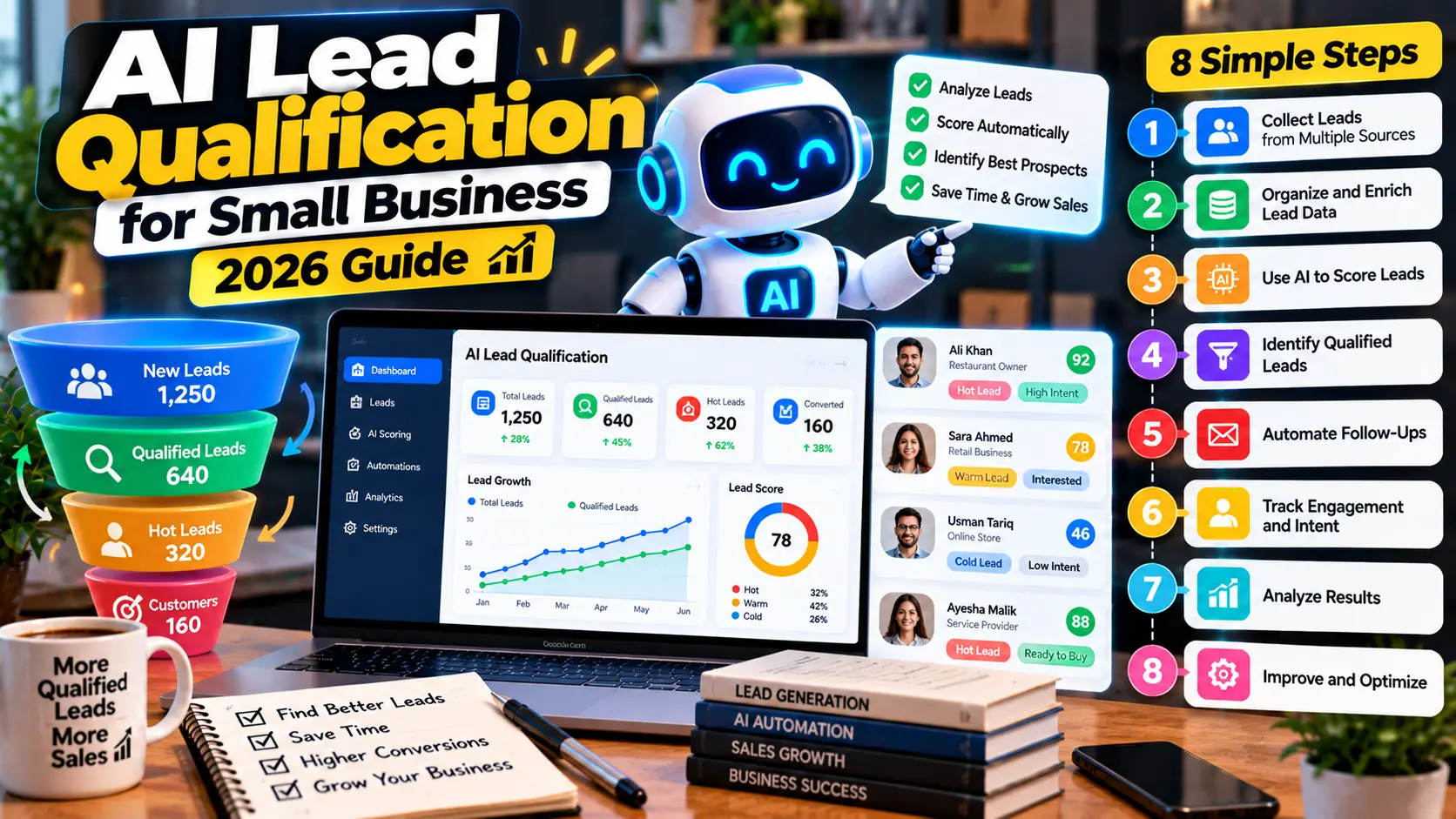
AI lead qualification for small business helps a sales team sort new inquiries, recognize missing information, and prepare a useful next step. Yet a model cannot reliably know whether a prospect will buy. Automated scores should support consistent follow-up, not replace conversation or quietly exclude people based on sensitive personal characteristics.
This practical 2026 guide covers eight steps from form design to CRM handoff. It focuses on transparent criteria, clear response times, consent, and human review. The process works for small agencies, B2B service firms, local businesses, and teams handling inquiries through a website, email, or approved chatbot.
What is AI lead qualification?
Lead qualification evaluates whether an inquiry fits an organization’s legitimate offer and whether the next step is a discovery conversation, a self-service resource, a different service, or no immediate follow-up. Typical business factors include the problem to solve, required capabilities, location served, urgency, and readiness to speak with a specialist.
AI can classify free-text messages, identify missing details, and suggest a routing category. However, the criteria must be set by the business, reviewed for fairness, and grounded in actual information. A numerical lead score is only a heuristic, not a prediction of a person’s worth or a guarantee of revenue.
8 steps to implement a reliable lead qualification workflow
Start with one inbound channel and a few objective criteria. The best first version usually routes requests to the right person and avoids slow or inappropriate responses.
1. Define what a qualified inquiry looks like
First, list the services you actually provide, the customer problems you can solve, and clear operational constraints such as supported markets or required project scope. Keep subjective stereotypes out of the definition.
For example, a custom-software agency might need to know the workflow being improved, required integrations, rough decision timing, and whether a decision-maker can attend a discovery call. A hobby question may need a guide instead of an immediate sales meeting.
2. Collect only information needed for the next step
Use a short form or approved conversational assistant. Ask about the business problem, service of interest, preferred contact route, and other details necessary for follow-up. Too many fields can prevent genuinely interested prospects from submitting.
In addition, explain how contact information will be used, apply appropriate consent or lawful-basis rules, and avoid requesting health, financial, or identity data unrelated to the service.
3. Normalize messages without inventing facts
Incoming leads may use different words for the same problem: “connect my stock to the shop” and “inventory integration” may describe a similar need. AI can propose consistent categories while preserving the original message.
Nevertheless, missing answers must stay missing. If no budget was discussed, record “not provided,” not a guessed amount. Keep exact customer wording available for the sales representative to inspect.
4. Build a simple transparent scorecard
Choose a small set of criteria that staff can explain: solution fit, problem urgency, relevant service availability, and readiness for an agreed next step. A sample scorecard might award 0–2 points for fit, 0–2 for urgency, and 0–2 for clarity of the request.
Those example numbers are not a verified conversion model. Before using scores, check whether the categories systematically disadvantage legitimate prospects or misrepresent one type of business. Always allow a person to override an incorrect classification with a recorded reason.
5. Set routing rules that are easy to audit
A high-fit inquiry might create an owner task for a timely discovery call. An incomplete request might trigger a short clarifying question. A request outside the business’s actual service area might receive an honest explanation and a helpful alternative.
Meanwhile, avoid sending the same lead to several employees without ownership. Save a unique inquiry ID, assigned person, due date, response state, and the reason for routing. This prevents repeated outreach and lost requests.
6. Use AI to draft a relevant first response
Write a draft that reflects the prospect’s actual question, explains the next step, and does not pretend that a human already reviewed the details. Keep dates, service capabilities, case-study results, and prices strictly tied to verified information.
Sample prompt: “Using only the prospect’s message and our approved service information, classify the request by service fit and missing details. Draft a concise reply that addresses their stated need, asks at most two necessary questions, and proposes an appropriate next step. Do not invent a price, promise a delivery date, or guess the prospect’s budget.”
7. Review CRM entries and sales handoffs
Before updating the CRM, compare AI-extracted fields with the actual inquiry. Separate confirmed requirements from assumptions and suggestions. For deals that may be financially material, a person should review the stage and forecast.
Connect the process to real sales conversations. Our AI sales call notes and follow-ups guide explains how to preserve confirmed customer commitments in CRM records.
8. Evaluate outcomes and correct mistakes
Finally, track first-response time, proportion of inquiries reaching the correct owner, correction rate, no-response cases, and qualified conversations that actually occur. Look beyond scores: an apparently low-fit lead might reveal a promising service need the current rules overlook.
Review a sample of decisions across different inquiry channels and business sizes. If the system repeatedly misroutes requests, improve the criteria and source data before increasing automation.
Worked example: a small software agency
Imagine two incoming messages. One business asks for a stock-and-sales integration for its existing store; another asks for general advice about learning to code. Both deserve an appropriate response, but their next steps differ. The first may qualify for a discovery call after clarifying its current platforms. The second may benefit from a helpful educational resource.
In this example, AI identifies the intent and suggests a reply. A human reviews the classification and can change it. The workflow supports service matching without labeling either person as inherently valuable or unimportant.
| Signal | Acceptable use | What to avoid |
|---|---|---|
| Stated business need | Match to offered services | Invented project requirements |
| Requested timeline | Prioritize time-sensitive follow-up | Assuming urgency from writing style |
| Service location | Check actual delivery coverage | Using unrelated personal demographics |
| Integration requirement | Route to technical specialist | Claiming unsupported integrations |
| Consent preference | Respect chosen contact method | Unapproved marketing outreach |
| Missing details | Ask a short clarifying question | Guessing budget or authority |
Privacy, fairness, and security controls
Only collect and share the data required for legitimate follow-up. Protect API credentials, restrict CRM access, and keep logs of significant automated changes. Do not use protected traits or unrelated personal details as shortcuts for deciding whether someone deserves a response.
For governance principles, see the NIST AI Risk Management Framework and our AI agent security guide. The right safeguards depend on the risks, applicable law, and the business context.
How to pilot AI lead qualification in 30 days
Begin with draft-only classifications that staff can compare against their existing qualification process. Do not automatically reject or delete inquiries in the pilot.
- Week 1: define service fit and remove unnecessary form fields.
- Week 2: classify a representative sample of actual inquiries and measure disagreements.
- Week 3: test owner routing and draft-only replies with human approval.
- Week 4: review response quality, fair handling, CRM accuracy, and conversion to appropriate conversations.
Mistakes that make lead automation underperform
Avoid building a complex scoring model before the team agrees on what it sells. Equally, do not use guessed budget, job title, or company size as a substitute for real needs. Another common error is answering every prospect with the same promotional paragraph.
A lead qualification system also needs an exit route. If an inquiry is not a good fit, respond respectfully when appropriate and record the reason. Silent deletion creates a poor customer experience and hides missed opportunities.
When to connect other sales tools
Once the process is accurate, connect scheduling, CRM reminders, proposals, and handoffs one at a time. Our AI appointment scheduling guide and AI proposal generator guide describe related workflows.
However, avoid giving one AI agent broad permission to send messages, change deal stages, and create financial commitments before the team has tested each action separately.
Frequently asked questions
Is AI lead scoring the same as qualification?
Not exactly. A score is one input; qualification includes actual needs, service fit, context, and a responsible next action.
Can AI automatically reject leads?
A business should be cautious. Unreviewed rejections can be inaccurate or unfair, especially when they rely on incomplete or sensitive data.
Do I need a CRM to start?
Not necessarily. A controlled spreadsheet and a clearly owned inbox can support a small pilot; a CRM becomes useful as volume and complexity increase.
How do I measure success?
Measure accurate routing, appropriate conversations, response time, and corrections. Do not assume that a higher automated score automatically means more revenue.
Final takeaway
AI lead qualification for small business works best as a transparent triage and handoff process. Start with objective service-fit rules, preserve original messages, ask about missing facts, and keep humans accountable for consequential decisions. To explore the broader sales context, read our AI sales assistant guide.

