


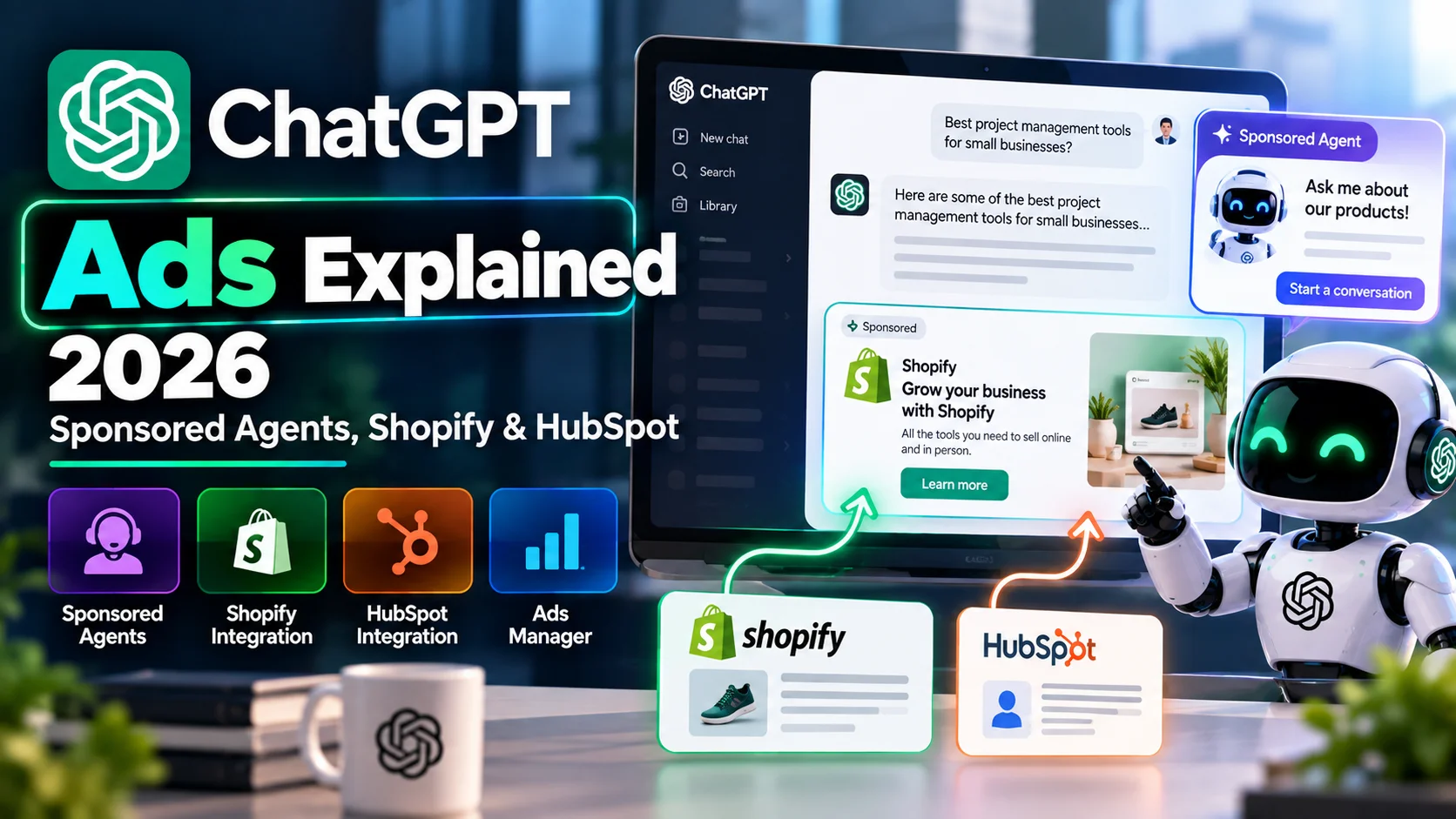
ChatGPT Ads Explained 2026: Sponsored Agents, Shopify & HubSpot
ChatGPT Ads are becoming much more than simple sponsored cards.
On September 16, 2026, OpenAI announced a broader advertising approach built around conversational AI. The update introduced Sponsored Agents, deeper Shopify and HubSpot integrations, AI-assisted campaign creation, and new tools for advertisers through OpenAI’s ChatGPT Ads announcement.
That direction matters because people increasingly use AI to research products, compare services, and make buying decisions.
Instead of showing only a traditional ad, ChatGPT Ads can connect an interested user with a business and, in some cases, allow that person to continue into a clearly labeled AI-powered conversation.
If you want to understand the technology behind this, read our AI Agents Explained guide.
What Are ChatGPT Ads?
ChatGPT Ads are paid placements that can appear separately from ChatGPT’s normal answers.
According to OpenAI’s ChatGPT Ads information, ads are clearly labeled as sponsored and operate separately from the system that generates ChatGPT’s answers.
Advertisers cannot pay to change or influence the answer itself.
A standard ChatGPT advertisement can include an advertiser name, logo, headline, description, landing page, and creative image.
However, OpenAI is now expanding the experience with conversational advertising formats.
What Are Sponsored Agents?
Sponsored Agents are one of the most interesting additions to ChatGPT advertising.
After seeing a relevant advertisement, a user may have the option to begin a separate conversation with an AI representative sponsored by that business.
For example, someone viewing an advertisement for business software could ask questions about features, integrations, pricing, or setup before visiting the advertiser’s website.
That creates a more interactive experience than a normal display advertisement.
Sponsored Agents are especially interesting because they combine advertising with the type of autonomous AI technology discussed in our AI Agents Explained article.
Are Sponsored Agents Available to Everyone?
Not yet.
OpenAI currently describes Sponsored Agents as a limited test available to selected advertisers.
Therefore, businesses should treat the feature as an emerging advertising format rather than something every advertiser can immediately activate.
You can check the latest details through OpenAI’s Sponsored Agents documentation.
How ChatGPT Ads Manager Works
OpenAI’s Ads Manager gives advertisers a self-service environment for creating and managing campaigns.
Businesses can manage:
- campaigns
- ad groups
- advertisements
- impressions
- clicks
- spending
- reporting
- account settings
OpenAI explains the current platform in its Ads Manager Beta overview.
This makes ChatGPT Ads more similar to established advertising platforms where marketers can create, monitor, and improve campaigns from one dashboard.
How Does ChatGPT Decide Which Ads to Show?
ChatGPT advertising can consider the context and intent of the current conversation.
For example, someone discussing accounting software may have a different intent from someone asking about graphic design tools.
That conversational context can help make advertisements more relevant.
OpenAI also allows advertisers to provide context around where their products or services may be useful.
However, this does not work exactly like traditional search keywords.
ChatGPT Ads and Shopify
OpenAI has introduced a dedicated ChatGPT Ads for Shopify integration.
The Shopify connection can help merchants connect product information with ChatGPT advertising.
This may include:
- product catalogs
- inventory information
- campaign creation
- commerce events
- conversion measurement
For ecommerce businesses, this could reduce the need to recreate products manually inside another advertising platform.
It may also make ChatGPT more useful as a product-discovery and shopping channel.
Why Shopify Integration Matters
Imagine a store with hundreds or thousands of products.
Manually creating advertisements for every item would take a significant amount of time.
A connected Shopify catalog can make the process more scalable.
In addition, conversion measurement can help marketers understand whether users who interact with ChatGPT Ads actually become customers.
This is important because clicks alone do not always produce revenue.
ChatGPT Ads and HubSpot
OpenAI also supports ChatGPT Ads in HubSpot.
This integration is particularly useful for businesses focused on leads rather than ecommerce sales.
A company could potentially move a lead from a ChatGPT advertising campaign into HubSpot and continue an existing sales or marketing workflow.
For example:
ChatGPT conversation → Advertisement → Lead → HubSpot CRM → Sales follow-up
This can be useful for agencies, consultants, software companies, and other service businesses.
For more business-focused AI ideas, read our How to Use ChatGPT for Business guide.
AI-Assisted Ad Creation
OpenAI is also bringing AI into the advertiser workflow.
Businesses can increasingly use AI to help generate campaign ideas, ad copy, creative concepts, and campaign variations.
That may reduce repetitive marketing work.
However, businesses should still manually verify:
- product claims
- pricing
- discounts
- legal statements
- availability
- promotional conditions
AI can help create content, but it should not be trusted to invent business facts.
Who Can See ChatGPT Ads?
OpenAI says advertising can appear for users on supported ChatGPT plans and markets.
Users on higher-tier business and premium plans may have different ad experiences.
Because availability can change, advertisers should check the latest Ads Manager availability before planning a campaign.
Where Is ChatGPT Ads Manager Available?
ChatGPT Ads Manager is expanding across multiple markets.
Availability can depend on the legal entity that will advertise and be billed.
Therefore, businesses should not assume that advertising access is available simply because ChatGPT itself works in their country.
The most reliable source is OpenAI’s current Ads Manager availability page.
Do Ads Influence ChatGPT Answers?
OpenAI states that advertisements are separate from ChatGPT’s generated responses.
Advertisers cannot pay to change or rank the assistant’s answers.
That distinction is important because people often use ChatGPT to compare products and services.
A sponsored advertisement may appear around the experience, but it is separate from the assistant’s independent response.
You can read more in OpenAI’s ChatGPT Ads information.
Do Advertisers See ChatGPT Conversations?
OpenAI says normal ChatGPT conversations are not automatically shared with advertisers.
However, there is an important distinction with Sponsored Agents.
If a user deliberately begins a conversation with a business-sponsored agent, the information they choose to send in that separate advertiser interaction may be shared with the sponsoring business.
That is why Sponsored Agents should be understood more like actively contacting a business.
ChatGPT Ads vs Google Ads
ChatGPT Ads and traditional search advertising start from different environments.
| Feature | ChatGPT Ads | Traditional Search Ads |
|---|---|---|
| Main environment | AI conversation | Search engine |
| User intent | Conversational context | Search query |
| Sponsored conversation | Sponsored Agents | Usually not |
| Ecommerce connection | Shopify | Product feeds |
| CRM integration | HubSpot | Multiple CRM options |
| Self-service campaigns | Yes | Yes |
| AI creative assistance | Built in | Increasingly common |
Neither platform automatically replaces the other.
Search advertising captures direct search intent.
ChatGPT advertising may capture intent expressed during a longer conversation.
ChatGPT Ads for Small Businesses
ChatGPT Ads may become useful for smaller businesses because self-service tools lower the barrier to entry.
However, the platform is still developing.
Businesses should begin carefully rather than immediately moving a large advertising budget.
A practical test could include:
- Start with a limited budget.
- Track clicks and conversions.
- Measure lead quality.
- Compare cost per customer.
- Compare performance with existing advertising channels.
Businesses already using AI can also read our Best AI Automation Tools for Small Businesses guide.
ChatGPT Ads for Ecommerce
Ecommerce businesses may be strong candidates for ChatGPT advertising.
The Shopify integration can simplify catalog management.
Meanwhile, Sponsored Agents could eventually help potential buyers ask questions before visiting a product page.
For example, a customer might ask:
- Does this product support my device?
- What size should I order?
- Is this suitable for my use case?
- What is the difference between these models?
A conversational advertising experience could answer those questions before the customer reaches checkout.
ChatGPT Ads for Service Businesses
Service businesses may use ChatGPT Ads differently.
Instead of promoting individual products, they may focus on leads.
For example, an agency could show an advertisement to a user discussing website development, AI automation, or digital marketing.
The interested user could then become a lead and enter a HubSpot workflow.
This makes conversational advertising potentially useful for B2B services.
Advantages of ChatGPT Ads
One of the biggest advantages is conversational context.
People often explain their requirements in much greater detail during an AI conversation than they would in a short search query.
That can create useful intent signals.
The platform also combines:
- Ads Manager
- Shopify integration
- HubSpot integration
- conversion tracking
- Sponsored Agents
- AI-assisted campaign creation
Together, these features could make ChatGPT Ads a unique advertising channel.
Limitations of ChatGPT Ads
The platform is still relatively new.
Sponsored Agents remain limited, and advertisers do not yet have the same amount of historical performance data available for mature platforms such as Google Ads or Meta Ads.
Availability also differs by location.
Therefore, businesses should test carefully and measure real outcomes.
Clicks and impressions alone are not enough.
Are ChatGPT Ads Worth Testing in 2026?
For businesses with access to the platform, ChatGPT Ads are worth watching closely.
The combination of conversational intent, Shopify, HubSpot, Ads Manager, and Sponsored Agents creates a different advertising experience from traditional search or social media campaigns.
However, businesses should treat ChatGPT Ads as an additional channel rather than immediately replacing proven advertising platforms.
The strongest advertisers will likely test it, measure results, and compare customer acquisition costs with their existing campaigns.
If you want a broader overview of ChatGPT itself, read our ChatGPT Review 2026.
Frequently Asked Questions
What are ChatGPT Ads?
ChatGPT Ads are clearly labeled sponsored placements that appear separately from ChatGPT’s normal answers. You can read OpenAI’s explanation on its ChatGPT Ads information page.
What are Sponsored Agents?
Sponsored Agents allow users to interact with a clearly identified AI representative sponsored by a business.
Can anyone use Sponsored Agents?
No. Sponsored Agents are currently being tested with selected advertisers and are not yet a standard feature for every advertiser.
Can Shopify stores use ChatGPT Ads?
Yes, OpenAI provides a ChatGPT Ads for Shopify integration for supported merchants and markets.
Does ChatGPT Ads work with HubSpot?
Yes. OpenAI provides a ChatGPT Ads in HubSpot integration for supported advertisers.
Do advertisers control ChatGPT answers?
No. OpenAI says advertising is separate from the assistant’s generated responses.
Are users’ normal conversations shared with advertisers?
OpenAI says normal ChatGPT conversations are not automatically shared with advertisers. Information may be shared when a user intentionally interacts directly with a sponsored business experience.
Conclusion
ChatGPT Ads are evolving from simple sponsored placements into a broader conversational advertising system.
Ads Manager provides campaign tools. Shopify connects ecommerce catalogs. HubSpot connects advertising with CRM workflows. Meanwhile, Sponsored Agents could allow users to move from seeing an advertisement to discussing an offer with a business-sponsored AI representative.
The platform is still developing, so businesses should test carefully.
However, the larger direction is important.
Online advertising may increasingly move from simply showing people advertisements toward helping people explore products and services through AI conversations.

