


Last updated: October 6, 2026
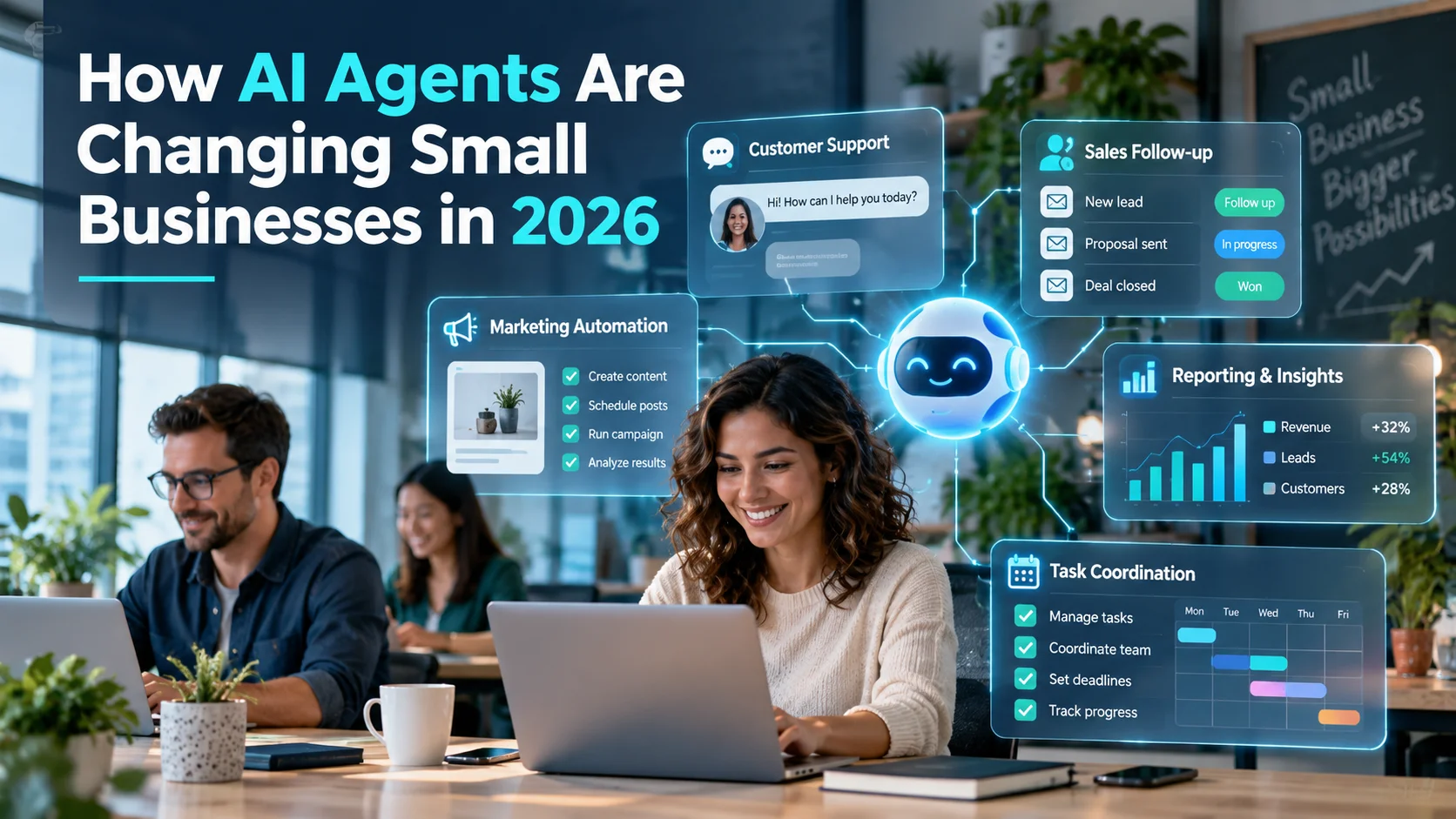
AI agents for small business are moving from experimental tools to practical digital workers that can handle multi-step tasks, use connected business apps, organize information, and take approved actions with less manual input.
For a small company, this matters because the same person often handles sales, customer service, marketing, operations, reporting, and administration. AI agents can reduce some of that workload by helping teams move from simply asking AI questions to assigning AI a goal and allowing it to complete a structured workflow.
The shift is already visible. Google Cloud has described 2026 as a year in which agentic workflows become a core part of business processes, while OpenAI’s recent small-business research reports growing use of agentic AI in areas such as finance, accounting, supply chain, legal and compliance work, and marketing.
But AI agents are not a magic replacement for employees. The strongest small-business use cases combine automation with clear rules, limited permissions, human review, and measurable business goals.
What Are AI Agents?
An AI agent is a system that can work toward a goal by reasoning through steps, using tools, accessing approved information, and taking actions within defined limits.
A traditional chatbot usually waits for a question and provides an answer. An AI agent can go further. Depending on how it is configured, it may be able to:
- read and classify incoming emails;
- look up customer information;
- update a CRM;
- prepare a follow-up message;
- create a task for a salesperson;
- summarize documents;
- compare information from several sources;
- trigger another workflow;
- request human approval before a sensitive action.
The important difference is action. Instead of only generating text, an agent can participate in a business process.
Why AI Agents Matter More for Small Businesses in 2026
Large companies can assign separate teams to marketing, operations, finance, customer support, analytics, and administration. Small businesses usually cannot.
That makes AI particularly useful when it increases the capacity of a small team without forcing the business to hire a specialist for every routine task.
OpenAI reported in 2026 that millions of people were already using ChatGPT to help plan, start, run, or grow businesses. More recent research from the company also shows that small businesses are using agentic AI heavily in functions where they may not have dedicated specialists.
At the same time, Google Cloud’s 2026 AI agent trends report says businesses are increasingly connecting agents into complete workflows rather than using isolated AI tools.
For small businesses, the practical opportunity is simple: use AI agents to reduce routine work while keeping people responsible for judgment, relationships, approvals, and strategy.
1. AI Agents Are Changing Customer Support
Customer service is one of the clearest areas where AI agents can help a small business.
A basic chatbot may answer frequently asked questions. An AI support agent can potentially do more by examining a request, identifying the issue, searching approved knowledge, checking account information, drafting a response, and routing difficult cases to the right person.
A support workflow could look like this:
Customer message → AI classifies issue → Knowledge base checked → Draft response prepared → Human review when needed → Ticket updated
This can reduce response time without forcing the business to automate every customer interaction.
Human escalation remains essential for refunds, complaints, legal issues, sensitive account changes, unusual cases, or situations where the AI is uncertain.
2. AI Agents Can Improve Lead Management and Sales Follow-Up
Small businesses often lose leads because inquiries arrive through several channels and follow-up is inconsistent.
An AI agent can help organize that process. For example, it may analyze a website inquiry, identify the requested service, estimate priority, add the lead to a CRM, assign an owner, prepare a personalized response, and create a follow-up reminder.
A practical workflow might be:
New lead → AI reads inquiry → Service identified → CRM updated → Salesperson assigned → Draft reply created → Follow-up scheduled
This does not mean the AI should negotiate important contracts or make pricing decisions independently. Instead, it can remove the administrative work that happens around the sales conversation.
3. Marketing Teams Can Move From Content Generation to Workflow Automation
Businesses have used generative AI for writing posts and emails for several years. AI agents add another layer by coordinating multiple marketing tasks.
An agent could help a small team:
- collect campaign ideas from approved sources;
- summarize customer feedback;
- organize a content calendar;
- prepare first drafts;
- repurpose long content into shorter formats;
- create review tasks for team members;
- compile performance data;
- prepare a weekly marketing summary.
The biggest improvement is not simply producing more content. It is reducing the manual coordination between research, drafting, review, publishing preparation, and reporting.
Businesses should still review claims, brand messaging, statistics, legal statements, and anything that could affect reputation.
4. Administrative Work Is Becoming Easier to Automate
Many small-business tasks are not difficult, but they consume time because they happen repeatedly.
Examples include:
- sorting emails;
- extracting information from documents;
- summarizing meetings;
- creating action items;
- updating spreadsheets;
- organizing files;
- preparing weekly reports;
- routing requests to the correct person.
AI agents can connect several of these steps into a single workflow.
If your business is still doing many repetitive tasks manually, our guide on how to automate repetitive business tasks with AI explains how to identify suitable processes and separate rule-based automation from AI-powered steps.
5. AI Agents Are Becoming Useful for Business Research and Decision Support
Small-business owners often need information quickly but do not have dedicated analysts.
An AI agent can assist with research by gathering approved data, summarizing documents, comparing options, extracting patterns, and preparing a structured brief.
For example, an owner might ask an internal agent to:
- summarize recent customer complaints;
- compare monthly sales trends;
- identify frequently requested services;
- review supplier documents;
- prepare a competitor research summary;
- organize meeting notes into decisions and action items.
The final business decision should remain with a person, especially when information may be incomplete or when the decision involves money, employees, customers, contracts, or legal obligations.
6. Finance and Document Work Can Be Faster—But Needs Strong Controls
Small teams spend significant time processing invoices, receipts, expense records, reports, and other business documents.
AI agents can help extract data, organize records, detect missing fields, categorize documents, and prepare information for review.
However, financial automation requires strict controls. An AI agent should not be given unrestricted authority to move money, approve large payments, change bank details, or submit important filings without verification.
A safer model is:
Document received → AI extracts data → System validates required fields → Human reviews exception → Approved data enters accounting workflow
This keeps AI focused on repetitive processing while a person remains responsible for high-impact decisions.
7. Multi-Step AI Workflows Are Replacing Isolated AI Tasks
One of the biggest changes in 2026 is the move from individual prompts to connected workflows.
Instead of using one AI tool to write an email and another system to update a CRM manually, businesses can create workflows where AI and traditional automation work together.
For example:
Website inquiry → AI understands request → CRM record created → Relevant service selected → Draft response prepared → Staff notified → Follow-up task added
Some steps require AI because they involve language or interpretation. Other steps are better handled by reliable rule-based automation.
This hybrid approach is usually more dependable than asking an AI agent to control every part of the process.
Examples of AI Agents for Small Business
| Business Area | Possible AI Agent Task | Human Role |
|---|---|---|
| Customer Support | Classify tickets and draft replies | Handle sensitive or unusual cases |
| Sales | Qualify leads and prepare follow-ups | Build relationships and close deals |
| Marketing | Research, organize and draft campaign content | Approve strategy and brand messaging |
| Operations | Route requests and update systems | Manage exceptions and process changes |
| Reporting | Summarize performance data | Interpret results and make decisions |
| Documents | Extract and organize information | Verify important records |
Benefits of AI Agents for Small Businesses
When implemented carefully, AI agents can create several practical advantages.
Less Repetitive Work
Employees can spend less time copying data, sorting messages, preparing routine summaries, and moving information between systems.
Faster Customer Response
Incoming requests can be categorized, enriched, and routed more quickly.
More Consistent Processes
A defined agent workflow can follow the same process each time, reducing forgotten steps.
Better Use of Small Teams
Owners and employees can spend more time on sales, relationships, creative work, problem-solving, and decisions that require human judgment.
Scalable Operations
A well-designed workflow can handle more requests without increasing manual administrative work at the same rate.
What AI Agents Should Not Control Alone
The excitement around AI agents can make full automation sound attractive. In practice, businesses should be careful about giving agents unrestricted access.
Human approval is strongly recommended for:
- large payments or refunds;
- banking changes;
- contract acceptance;
- legal advice or legal submissions;
- employee hiring or termination decisions;
- sensitive customer account changes;
- high-value quotations;
- security permissions;
- public statements that could create reputational risk.
An AI agent can prepare information for these decisions. It should not automatically become the final decision-maker.
How Small Businesses Can Start Using AI Agents
Step 1: Choose One Repetitive Problem
Do not start by trying to create an AI-powered business that automates everything.
Choose one clear problem, such as slow lead follow-up, repetitive customer questions, manual report preparation, or document processing.
Step 2: Write Down the Current Process
Document what happens today from beginning to end. This exposes unnecessary steps and shows where AI may actually help.
Step 3: Separate Rules, AI and Human Decisions
Use normal automation for predictable steps. Use AI where interpretation is needed. Keep people involved where judgment or risk is high.
Step 4: Give the Agent Minimum Necessary Access
An agent should only have access to the tools and information required for its task.
For example, a support agent that only needs to read a knowledge base and create ticket drafts does not need access to financial systems.
Step 5: Test With Realistic Scenarios
Test normal cases, unusual cases, incomplete information, incorrect customer details, and situations where the agent should stop and ask for help.
Step 6: Measure the Result
Track whether the workflow actually improves the business.
Useful measurements may include:
- time saved;
- response time;
- error rate;
- number of manual steps removed;
- lead response rate;
- support resolution time;
- employee satisfaction;
- cost per completed workflow.
Choosing the Right AI Automation Platform
The best platform depends on your existing software, team skills, budget, workflow complexity, and required level of control.
Some businesses need simple no-code automation. Others need visual multi-step workflows, APIs, custom logic, or self-hosted systems.
If you are comparing platforms, see our guide to the best AI automation tools for small businesses in 2026. It covers popular options and explains where each type of automation platform fits.
Risks Small Businesses Should Manage
AI agents can save time, but they also introduce risks that should be designed around from the beginning.
Incorrect Outputs
AI can misunderstand a request, use incomplete information, or generate an incorrect answer.
Too Much Access
An agent with unnecessary permissions can create avoidable security and privacy risks.
Hidden Workflow Failures
Businesses should log important agent actions and monitor failures instead of assuming every automated run succeeded.
Poor-Quality Data
An agent cannot reliably make good decisions when customer records, inventory information, instructions, or knowledge sources are inaccurate.
Over-Automation
Not every task needs AI. Simple rule-based automation is often faster, cheaper, and more reliable.
Will AI Agents Replace Small-Business Employees?
For most small businesses, the more useful question is not whether AI agents will replace employees. It is which repetitive parts of a job can be delegated so employees can spend more time on higher-value work.
A salesperson still needs communication and relationship skills. A support employee still needs empathy and judgment. An owner still needs to make strategic decisions.
AI agents are strongest when they operate as an additional layer of capacity around those people.
The Future of AI Agents for Small Business
AI agents are likely to become less visible as a separate category of software and more deeply embedded inside the tools businesses already use.
Email platforms, CRMs, help desks, productivity suites, accounting systems, marketing tools, and workflow platforms are increasingly adding agent-like capabilities.
The long-term change is therefore not simply that businesses will “use an AI agent.” It is that everyday software will be able to understand goals, coordinate steps, and complete more work across connected systems.
For small businesses, the advantage will come from designing these systems carefully rather than adopting every new AI feature.
Frequently Asked Questions
What are AI agents for small business?
AI agents for small business are AI-powered systems that can work toward a defined goal, use connected tools, process information, and take approved actions across business workflows.
How are AI agents different from chatbots?
A chatbot mainly responds to messages. An AI agent can potentially plan steps, use tools, access approved data, update systems, trigger workflows, and complete tasks within defined permissions.
What can a small business automate with AI agents?
Common use cases include lead qualification, customer-support triage, email organization, document processing, reporting, research, CRM updates, marketing workflows, and internal task coordination.
Do AI agents require coding?
Not always. Many automation platforms provide no-code or low-code interfaces. More advanced workflows involving custom systems, APIs, databases, or complex logic may require technical expertise.
Are AI agents safe for business?
They can be used safely when permissions are limited, sensitive actions require approval, data access is controlled, activity is logged, and workflows are tested and monitored.
Should a small business automate everything?
No. Start with one repetitive, measurable process. Keep simple tasks rule-based and use AI only where interpretation, summarization, classification, generation, or reasoning creates real value.
Final Thoughts
AI agents are changing small businesses in 2026 by turning AI from a tool that only answers questions into a system that can participate in real workflows.
The biggest opportunities are not flashy demonstrations. They are practical improvements: faster lead handling, better customer support, less administrative work, quicker research, more organized operations, and more consistent follow-up.
The best approach is to start small, keep people in control of important decisions, give agents only the access they need, and measure whether each workflow actually saves time or improves service.
Small businesses that follow that approach can use AI agents as a force multiplier without giving up the human judgment that customers, employees, and business decisions still require.

