
Best AI Tools for Content Creation in 2026

Explore the best AI tools for content creation in 2026, including ChatGPT, Claude, Jasper, Canva, and Grammarly, with practical use cases and key strengths.
Jasper vs Copy.ai: Which AI Writing Tool Is Better in 2026?

Choosing between Jasper vs Copy.ai is no longer as simple as comparing two AI writing assistants. Both platforms started with a strong focus on AI-generated content. However, they have evolved considerably. Jasper now focuses heavily on brand-controlled marketing, campaigns, AI agents, and enterprise marketing workflows. Copy.ai, meanwhile, has expanded into a broader go-to-market AI platform that connects content, sales, marketing, research, and automated workflows. Therefore, the right choice depends less on which tool can generate a blog post and more on how you plan to use AI across your business. In this Jasper vs Copy.ai comparison, we will look at writing, brand voice, automation, workflows, pricing, ease of use, marketing capabilities, and business applications. If you are still exploring the wider AI writing market, our guide to best AI writing tools for bloggers is also useful. Jasper vs Copy.ai: Quick Comparison Feature Jasper Copy.ai Main focus Marketing teams and brand-controlled content Go-to-market automation and workflows AI writing Excellent Excellent Brand voice Strong Strong Marketing campaigns Major focus Supported through workflows Workflow automation Available through agents, integrations and tools Core part of the platform Sales workflows Less central Major focus Team collaboration Strong Strong Multiple AI models Platform-managed AI capabilities OpenAI, Anthropic and Gemini access on Chat plan Best suited for Marketing teams, agencies and brand teams GTM, sales, marketing and operations teams Entry pricing Jasper Pro currently listed at $69/month monthly or $59/month billed annually Copy.ai Chat currently listed at $29/month or $24/month billed annually Pricing can change, so always check each platform’s official pricing page before purchasing. Jasper currently lists Pro at $69 per month when billed monthly or $59 per month when billed annually. Copy.ai currently lists its Chat plan at $29 monthly or $24 per month when paid annually. What Is Jasper? Jasper is an AI platform built primarily around marketing. It has moved far beyond basic AI copywriting. Jasper describes itself as a marketing agents platform designed to help organizations execute marketing work while maintaining brand control and consistency. Its current ecosystem includes tools for content creation, marketing campaigns, AI agents, brand intelligence, brand voice, style guidelines, audiences, knowledge, and other marketing activities. One of Jasper’s most important components is Jasper IQ. It acts as a brand intelligence layer where companies can define their voice, knowledge, audiences, style guide, and visual standards. Those settings can then influence content generated across Jasper’s tools. As a result, Jasper is particularly attractive to businesses that create large amounts of marketing material but need consistent messaging. What Is Copy.ai? Copy.ai has also evolved beyond traditional AI copywriting. Today, the company positions the product as a GTM AI platform, with GTM meaning go-to-market. Its goal is to connect processes across marketing, sales, customer success, research, and revenue operations rather than simply generate individual pieces of content. Copy.ai still offers AI writing and chat capabilities. However, workflows have become a major part of the platform. For example, businesses can build multi-step workflows combining actions such as text generation, research agents, web-based research and other processes. Copy.ai says these workflows can be customized and triggered automatically for repeatable business operations. Consequently, Copy.ai may appeal to companies that want AI to do more than write. Jasper vs Copy.ai for AI Writing For straightforward AI writing, both tools are capable. You can use either platform to help create blog drafts, emails, marketing copy, product descriptions, social media content, campaign assets, and other business text. The larger difference appears when you look at the environment surrounding the writing process. Jasper is built around marketing consistency. Instead of treating every prompt as an isolated request, businesses can provide Jasper with brand knowledge, voice, audience information, and style rules. This approach can reduce the amount of repeated prompting required when several team members create content. Copy.ai also supports Brand Voice. Users can provide examples of existing content, and the system can analyze them to generate material that matches the desired style. Multiple voices can also be created for different audiences or authors. Therefore, both platforms offer more sophisticated brand control than a basic chatbot. Jasper vs Copy.ai for Brand Voice Brand consistency is one of Jasper’s strongest areas. Jasper allows users to create Brand Voices using existing writing examples. Its documentation says users can provide text, documents or URLs that Jasper analyzes to understand tone, style and other characteristics. Brand Voice also connects with the wider Jasper IQ environment. This matters for agencies and businesses managing several brands because content creators do not need to manually explain the same tone and positioning in every prompt. Copy.ai also provides a strong Brand Voice system. Existing on-brand content can be analyzed, while users can also manually define distinct voices. The feature is designed to maintain consistency across different marketing channels. The practical difference is positioning. Jasper places brand governance near the center of its marketing platform. Copy.ai treats Brand Voice as one component within a broader GTM automation environment. For a company whose main concern is consistent marketing content across campaigns, Jasper’s approach may feel more focused. For a company that wants brand voice to work alongside automated GTM processes, Copy.ai may fit more naturally. Jasper vs Copy.ai for Marketing Campaigns Jasper has a particularly strong marketing orientation. Its campaign capabilities are designed to take campaign information and help create assets across channels such as social media and email. Jasper also supports content repurposing and collaboration around campaign work. For example, a marketing team could begin with a campaign brief and then use the platform to develop multiple related assets while maintaining the same brand direction. This is useful because one campaign often requires several formats: email copy, landing-page messaging, social content, advertisements, product messaging and supporting material. Instead of creating each asset independently, a marketing-focused platform can help keep them aligned. Copy.ai can also handle marketing processes. However, its broader strength is turning repeatable marketing and sales activities into workflows. So, if your primary requirement is campaign execution and brand-controlled marketing content, Jasper deserves close consideration. Jasper vs
Best AI Writing Tools for Bloggers in 2026: Top Tools Compared
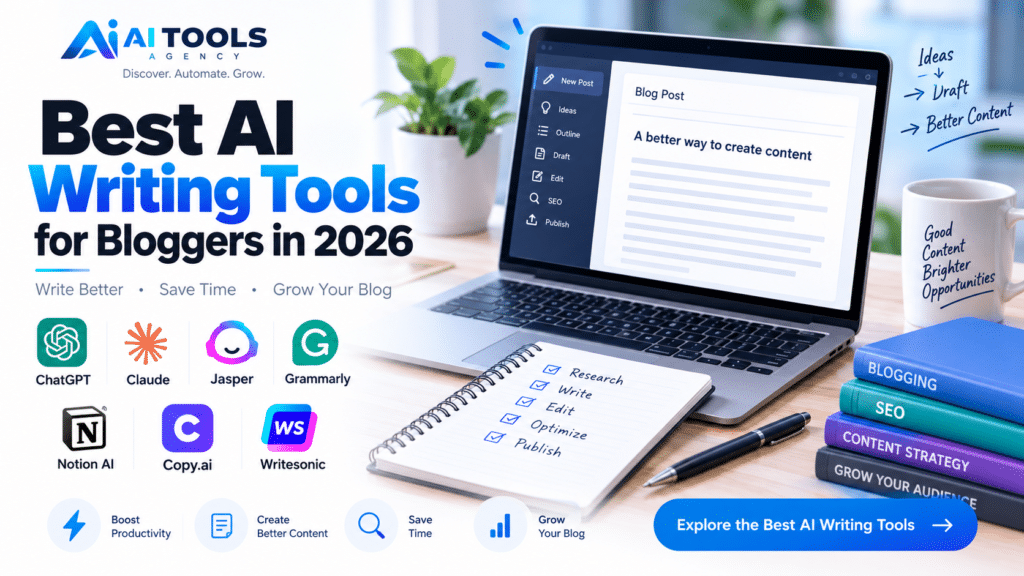
Finding the best AI writing tools for bloggers can save hours of research, drafting, editing, and content planning. In 2026, AI writing platforms can help bloggers generate ideas, build detailed outlines, improve existing drafts, research topics, optimize content, and create better articles faster. In this guide, AI Tools Agency compares the best AI writing tools for bloggers, including ChatGPT, Claude, Jasper, Grammarly, Notion AI, Copy.ai, and Writesonic, so you can choose the right platform for your blogging workflow. AI has changed the way bloggers research topics, create outlines, draft articles, edit content, and optimize their websites. Instead of spending hours staring at a blank page, bloggers can now use artificial intelligence to speed up repetitive parts of the content creation process. But there is an important difference between using AI to assist your writing and simply asking an AI tool to generate hundreds of generic articles. The best AI writing tools for bloggers help with research, brainstorming, structure, editing, productivity, and optimization while still giving the writer control over the final content. In this guide, AI Tools Agency compares some of the best AI writing tools for bloggers in 2026 and explains which type of blogger each platform is best suited for. Affiliate Disclosure: Some links on this page may be affiliate links. AI Tools Agency may receive a commission if you purchase through one of these links, at no additional cost to you. Our recommendations are based on features, use cases, and overall usefulness. What Is an AI Writing Tool? An AI writing tool is software that uses artificial intelligence to help users create, improve, organize, or research written content. Depending on the platform, an AI writing assistant can help you generate blog ideas, create outlines, rewrite sentences, summarize research, improve grammar, develop headlines, draft social posts, create FAQs, and repurpose existing articles. Modern AI platforms have also expanded beyond basic text generation. Some can search the web, analyze files, work with images, access workspace information, and perform multi-step research. The result is that bloggers can now use AI throughout almost the entire content workflow. However, AI should not replace your experience, editorial judgment, fact-checking, or unique perspective. Best AI Writing Tools for Bloggers: Quick Comparison AI Tool Best For Main Strength ChatGPT Best overall Research, drafting, brainstorming and editing Claude Long-form content Natural writing and document analysis Jasper Marketing teams Brand-focused content workflows Grammarly Editing Grammar, clarity and rewriting Notion AI Content organization Writing inside a productivity workspace Copy.ai Marketing workflows GTM and business content automation Writesonic SEO-focused teams Content plus SEO and AI-search visibility 1. ChatGPT — Best Overall AI Writing Assistant ChatGPT is one of the most versatile options for bloggers because it can assist with almost every stage of content production. You can use it to brainstorm topics, analyze an audience, develop content briefs, create outlines, rewrite paragraphs, summarize information, generate FAQs, improve headlines, and review drafts. ChatGPT can also work with uploaded files and, depending on the available plan and features, search the web, perform deeper research, analyze data, and work with images. OpenAI currently documents capabilities including web search, deep research, file analysis, image functionality, data analysis, voice, memory, and Projects. Why Bloggers May Like ChatGPT Its biggest advantage is flexibility. Instead of being built exclusively for blogging, it can act as a research assistant, editor, strategist, brainstorming partner, or content planner. For example, instead of asking: “Write an article about email marketing.” A better workflow would be to provide your target audience, search intent, main keyword, competing topics, desired tone, products you want mentioned, and personal experience. You can then use ChatGPT to help structure the article while writing the important insights yourself. Best For ChatGPT is particularly useful for independent bloggers, affiliate marketers, content creators, small businesses, SEO teams, and agencies that need one AI platform for many different tasks. 2. Claude — Excellent for Long-Form Writing Claude is another strong choice for bloggers, particularly when working with longer documents. It is useful for analyzing existing drafts, rewriting awkward sections, summarizing source material, organizing complex ideas, and helping transform notes into a clearer article structure. For long-form bloggers, one of the most valuable workflows is uploading background material and asking Claude to identify important themes, missing arguments, repetitive sections, or opportunities to improve clarity. Why Bloggers May Like Claude Claude often works well when you provide substantial context. That makes it useful for articles where you already have research notes, product documentation, interview transcripts, competitor observations, or an earlier draft. Instead of generating an article from nothing, you can use it as an editorial partner. Best For Long-form writers, researchers, editorial teams, educational bloggers, and content creators working with large amounts of source material. 3. Jasper — Best for Marketing Teams Jasper has evolved into a broader marketing-focused AI platform rather than simply being a basic writing generator. Its current platform emphasizes marketing workflows, brand consistency, specialized agents, content pipelines, research, optimization, and brand context. Jasper also offers tools specifically for blog writing and SEO workflows. This makes Jasper more attractive to businesses producing content across multiple channels. Why Bloggers May Like Jasper A solo blogger may not need every feature Jasper provides, but agencies and marketing teams can benefit from its structured workflow. For example, a company could establish a consistent brand voice and use AI across blog posts, advertising, email campaigns, social media, and landing pages. Jasper’s current Pro plan is positioned for professional marketing use, while its Business offering targets larger organizations. Best For Marketing departments, content agencies, established brands, and teams that need consistency across a large amount of content. 4. Grammarly — Best for Editing and Polishing Grammarly remains valuable because AI-generated content still needs editing. A blogger may create an excellent outline and first draft but still have sentences that are unnecessarily long, repetitive, unclear, or grammatically incorrect. Grammarly can help identify those problems directly while you write. Its AI writing functionality can also assist with brainstorming, drafting, rewriting, and adjusting tone. Grammarly currently

