


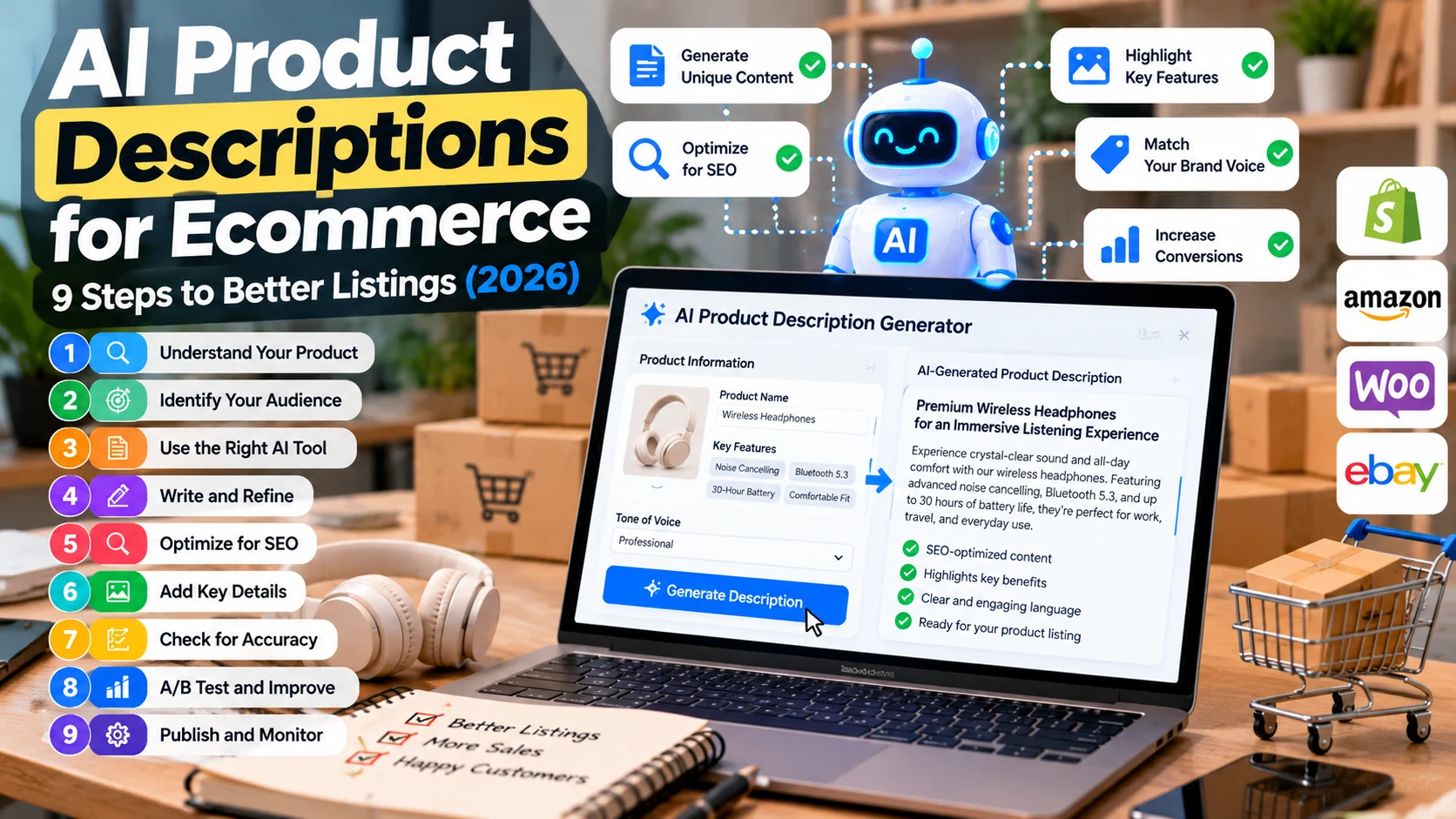
An online store may carry hundreds of products, each requiring a useful title, description, specification list, and customer-friendly explanation. AI can accelerate the first draft, but a faster description is not necessarily a better one. Inaccurate sizes, unsupported claims, and duplicated copy can undermine trust and create avoidable support requests.
This guide explains a practical workflow for AI product descriptions for ecommerce in 2026. It focuses on accurate catalog data, helpful writing, and quality controls rather than automated keyword stuffing or promises of guaranteed sales.
What can AI do for ecommerce product descriptions?
An AI writing assistant can turn approved product specifications into readable descriptions, reorganize benefits, produce alternative headlines, draft short snippets, and adapt copy for distinct customer questions. It should not invent test results, materials, warranty periods, certifications, delivery promises, or compatibility.
Product pages serve two audiences. Shoppers need clear answers that support a purchase decision; search engines need accessible, unique, well-structured content that matches the page. Improving clarity benefits both, but AI-generated wording alone does not establish usefulness.
9 steps to create useful AI product descriptions
1. Collect a verified product fact sheet
Gather approved information before prompting the tool: product name, brand, model, materials, measurements, weight, colors, available variants, included accessories, care requirements, price or pricing rules, warranty, and applicable warnings. Identify which details are fixed and which vary by configuration.
Use a consistent source of truth, such as a product information management record or maintained spreadsheet. If a field is missing, mark it unknown. Do not ask AI to fill blank specifications from intuition.
2. Identify the target customer and search intent
A shopper seeking “portable laptop stand for travel” may care about folded size, stability, and compatibility. Someone seeking “office monitor riser” may care more about desk organization and height. Write for the actual intended use and avoid describing every item as suitable for every audience.
Review customer questions, site search data, and legitimate product reviews to identify information that a page currently misses. Keep the writing natural rather than repeating a keyword every sentence.
3. Define an output structure before generating
A useful page often contains a concise opening, a short list of benefits, accurate specifications, practical use cases, care or compatibility details, and answers to common questions. Define the intended length and avoid excessive promotional adjectives.
For example, a 120-word overview could describe the central use case, followed by structured specifications and a short FAQ. Different product types will require different templates.
4. Prompt from evidence, not imagination
Provide only confirmed attributes and instruct the model not to invent facts. You can adapt this template:
Write a clear ecommerce product description using only the verified facts below. Begin with the main use case, explain three concrete benefits, add a concise specification list, and include two customer questions. Keep measurements and compatibility exact. Do not add certifications, warranty claims, reviews, performance results, or other details not supplied. Flag missing information for a human editor.
Test outputs against the original product record, especially when generating in bulk. A confident sentence can still be factually incorrect.
5. Write benefits that follow from verified features
A feature is an attribute: “folds flat to 18 mm.” A benefit explains its practical meaning: “fits into a slim bag compartment.” The benefit must follow reasonably from the specification and should not imply an unverified performance claim.
Replace vague copy such as “revolutionary, premium, perfect for everyone” with useful information about who might benefit and under what conditions. If the item has limitations, make them visible.
6. Handle product variants without contradictions
Sizes, finishes, capacities, and bundle contents may differ across variants. State variant-specific information beside the correct selection and ensure that the description does not promise features absent from some versions. A product available in three colors should not say “available only in black” because an outdated prompt contained one example.
Where variants have separate URLs, avoid creating near-identical pages with meaningless word changes. Follow your platform’s canonical and product-page architecture.
7. Align title tags, headings, and product details
Give each important product a descriptive name and unique page title where appropriate. Use readable headings, meaningful image alt text, and product data that matches the visible page. Relevant structured product data can help search engines understand attributes, but markup must represent what users actually see.
Google’s Product structured data documentation explains eligibility and requirements. Structured data is not a shortcut to guaranteed rich results.
8. Match words with accurate product imagery
Good visuals answer questions about scale, details, color, and typical usage. AI-generated lifestyle scenes may be helpful for conceptual marketing, but should not misrepresent exact features or included parts. For an image workflow and its limitations, see AI product photography for ecommerce.
Use genuine product images for exact specifications and product condition. Label illustrative images when a buyer could otherwise mistake them for literal photographs of the item sold.
9. Review, publish carefully, and measure useful outcomes
Before publishing, compare each claim with the supplier or internal specification sheet. Check grammar, localization, currency, unit conversion, mobile readability, links, accessibility, and consistency with checkout information. In regulated categories, seek appropriate legal or compliance review.
Measure returns caused by wrong descriptions, unanswered customer questions, product-page engagement, and conversion rates in context. A rise in clicks is not helpful if buyers receive products that fail to match the description.
Before-and-after example: portable laptop stand
| Weak description | Improved information-first approach |
|---|---|
| “Amazing stand with unbeatable quality. Ideal for everyone!” | “A foldable laptop stand designed for desk and travel use. Check the listed supported device sizes and load limit before ordering.” |
| “Works with all laptops.” | “Compatible with the models or size range verified in the specifications.” |
| “Premium aluminum, lifetime warranty.” | Only mention material and warranty if the approved product record confirms them. |
These statements are examples of editorial technique, not descriptions of an actual product. Exact compatibility, materials, and measurements must always be supplied by a verified source.
Bulk generation: how to avoid repeated low-value listings
Generating thousands of descriptions at once amplifies small errors. Start with a sample of products representing different categories, variant types, and information quality. Review every output in the pilot. Create a checklist for prohibited claims and uncertain specifications. Only expand after the team understands recurring mistakes and has a correction process.
AI can propose unique writing angles for different use cases, but do not manufacture distinctions where products are essentially identical. The best catalog improvements usually begin with better source data and clearer customer questions.
SEO mistakes to avoid
- Publishing generic copy that could describe dozens of unrelated products.
- Repeating keywords unnaturally in every heading and paragraph.
- Inventing reviews, testimonials, or performance claims.
- Using product schema values that disagree with visible prices or availability.
- Describing one variant as though it represents the entire range.
- Using attractive images that suggest features not included in the purchase.
- Skipping customer-facing care, compatibility, or return information.
Frequently asked questions
Can AI write all product listings automatically?
It can generate drafts at scale, but product facts, compatibility, and claims still need appropriate validation. Fully unattended publication increases the risk of repeated errors.
Should every product description be long?
No. Use the length needed to help the customer decide. A simple accessory may need less copy than a technically complex device.
Does AI-written ecommerce content rank on Google?
Search performance depends on helpfulness, relevance, originality, site signals, and many other factors. AI authorship alone neither guarantees nor prevents indexing.
How do I avoid invented specifications?
Supply a verified product fact sheet, prohibit unsupported additions in the prompt, and check a representative sample against source records before publication.
Final checklist
Before publishing an AI-assisted product page, confirm facts, variants, customer questions, images, SEO fields, and fulfillment details. A trusted store needs accurate information more than fluent promotional language. For wider creative workflows, explore AI tools for content creation.

